
The Roman Empire (A2-B1)
Section outline
-
Ancient Rome was the centre of one of the largest and most powerful empires in history. With its centre in today’s Italy, the Roman Empire conquered the whole Mediterranean region and spread its influence to the Middle East, Northern Africa, Western and Central Europe. It reached the height of its power between 100 and 200 A.D. Afterwards, the Roman Empire began to collapse because it became too big to rule. The West Roman Empire ended in 476 A.D. when Germanic tribes invaded, the East Roman Empire continued to exist for many centuries.
The ancient Romans influenced countries and civilizations in the following centuries. Their language, Latin, became the basis for many other European languages. Governments and legal systems in the western world were founded on Roman law. The ancient Romans were the first to build bridges, concrete roads and a sewage system that took waste water away from houses and homes.
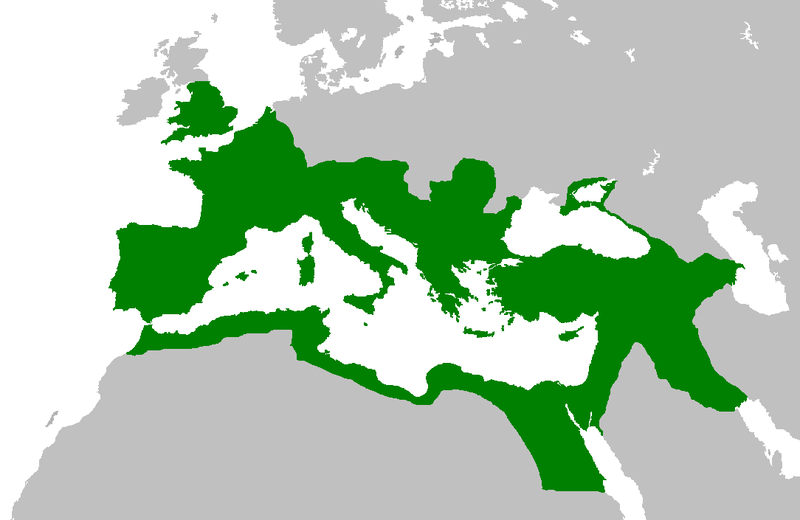
The Roman Empire at the height of its power
Image : User:Jrockley / User:Kasper Holl, CC BY-SA 3.0,
via Wikimedia CommonsWords
- A.D. = after the birth of Christ
- ancient = old, from a long time ago
- century = a period of a hundred years
- collapse = break apart
- concrete = material that consists of sand, cement, stones, and water
- conquer = to take control of a country by fighting
- empire = group of countries that are controlled by a single ruler or king
- found-founded = start ; here: to be based on
- government = the people who rule a country
- height = highest point
- influence = power
- invade = to enter a country with an army
- legal = about the law
- Mediterranean = area between Europe and Africa
- rule = govern, control
- sewage system = human waste and used water is carried away in underground pipes and canals
- spread = here: to make larger
- tribe = group of people who belong to the same race and have the same traditions and language
- waste water = used water that is not clean
-
