
The History of Ancient Rome
According to legends, ancient Rome was founded on 7 hills in the 8th century before Christ by Remus and his brother Romulus, who became the first king of Rome. Its early inhabitants were called the Latins, who lived on the fertile plains of Latium. During its early history, ancient Rome was controlled by the Etruscans, people who lived in northern Italy. At that time they were the most modern civilization in Italy. Rome grew steadily under Etruscan influence. At about 500 B.C., the Etruscan occupation ended and Rome became a republic.
The Roman Republic
The republic was governed by two consuls. They were chosen by an assembly of men. The Senate was an institution that advised the consuls. Although it was weak at first, its power grew gradually. By this time, Rome was the largest city in Latium. In the following centuries, it conquered many smaller towns around it. By the third century B.C. Rome ruled over most of the Italian peninsula.
At about 400, Rome was under attack by Gauls, who occupied northern Italy. Although they invaded Rome and burned down the city in 390 B.C., the Romans fought back and defeated the Gauls. Between 264 and 146 B.C. Rome fought three wars against Carthage, a sea power located in today’s Tunisia.
The Punic Wars brought most of Northern Africa and Spain under Roman control. A famous Carthaginian general, Hannibal, wanted to attack Rome from the north. He led his soldiers over the Alps and invaded Italy from the north, but in the end he was defeated. In 146 Carthage was destroyed.
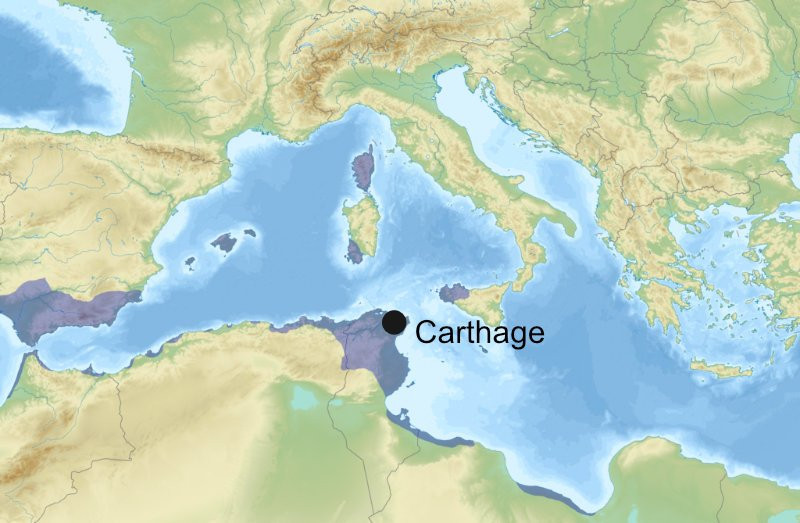
Ancient Carthage and the lands controlled by it
Image (altered) : Aldan-2, CC BY-SA 4.0,
via Wikimedia Commons

By 150 B.C. Rome had expanded its influence eastward and took control of Greece, which became one of Rome’s richest provinces. Because faraway territories could not be directly ruled, governors, called proconsuls, were put in charge of the conquered territories. Many people were taken as slaves and brought back to Rome to work as servants or on farms.
In the first century B.C. ancient Rome suffered from power struggles and civil wars. Senators, generals, and tribunes fought for power. When an important Roman general, Julius Caesar, came back to Italy after defeating Gaul, another civil war began. Caesar’s supporters helped him win over his rivals, and Julius Caesar became the sole ruler of Rome. However, many Romans didn’t trust him and in 44 B.C. he was assassinated.
The Roman Empire
The assassination of Julius Caesar led to the downfall of the Roman Republic. Augustus became the first Roman emperor in 27 B.C. After the government of the people had been destroyed, the Romans wanted a strong ruler who would give them peace and prosperity. For the next 200 years Roman emperors were very strong.
Although the emperors had ultimate power, Senators and other representatives elected by the people still existed. Augustus controlled the army and appointed new Senators and consuls. He also created strong fortifications along the borders of the Roman Empire, which extended to Britain and the Danube River.
Economically, Rome was now at its height. There were large farms in rural areas that produced food for an ever-growing population. Throughout the empire, the Romans built roads that made it possible to bring troops and supplies to other parts of the empire.
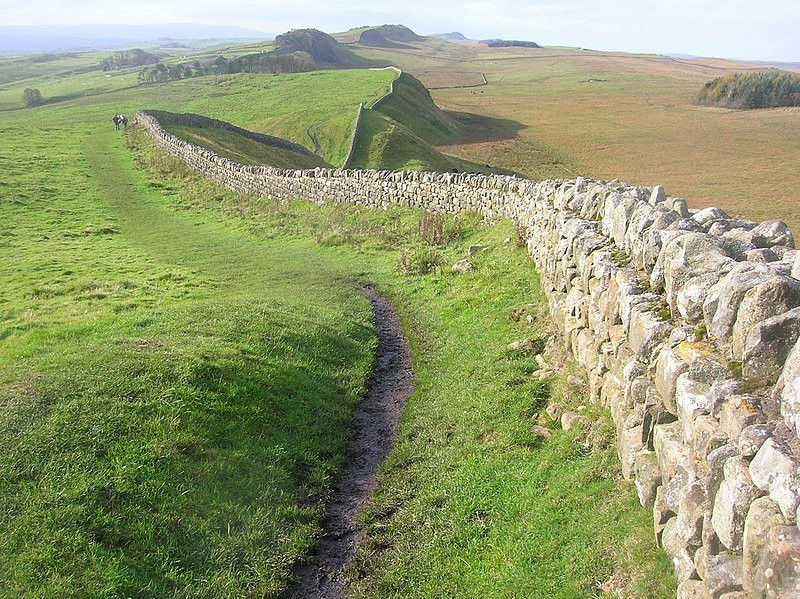
Section of Hadrian’s wall – a border wall in the north of the U.K.
Image: quisnovus from Gloucester, England, CC BY 2.0,
via Wikimedia Commons

Decline of the Roman Empire
One of the reasons for the Roman Empire’s decline is that it became too much too big. A single ruler could not efficiently rule such a large territory. During the second century A.D. Germanic tribes from the north started attacking Rome. The empire was defended by Marc Aurelius, one of the great emperors of the period.
When Diocletian became emperor in 284 A.D. he tried to reorganize the empire and divide it into smaller areas. One of his successors, Constantine the Great, permanently divided the empire into two parts: an east Roman Empire with its capital Constantinople and a west Roman Empire with Rome as its capital city. Constantine granted freedom to the Christians and promised not to persecute them any longer. He also became the first ruler to convert to Christianity.
In the 5th century, Germanic tribes kept moving to the south and invaded the Roman Empire. Vandals invaded Rome and plundered the city. In 476 A.D. Odoacer, a German tribal leader forced the Roman emperor to give up power. The east Roman Empire survived for almost another thousand years. In 1453, the Ottomans conquered Constantinople and made it centre of the Ottoman Empire.
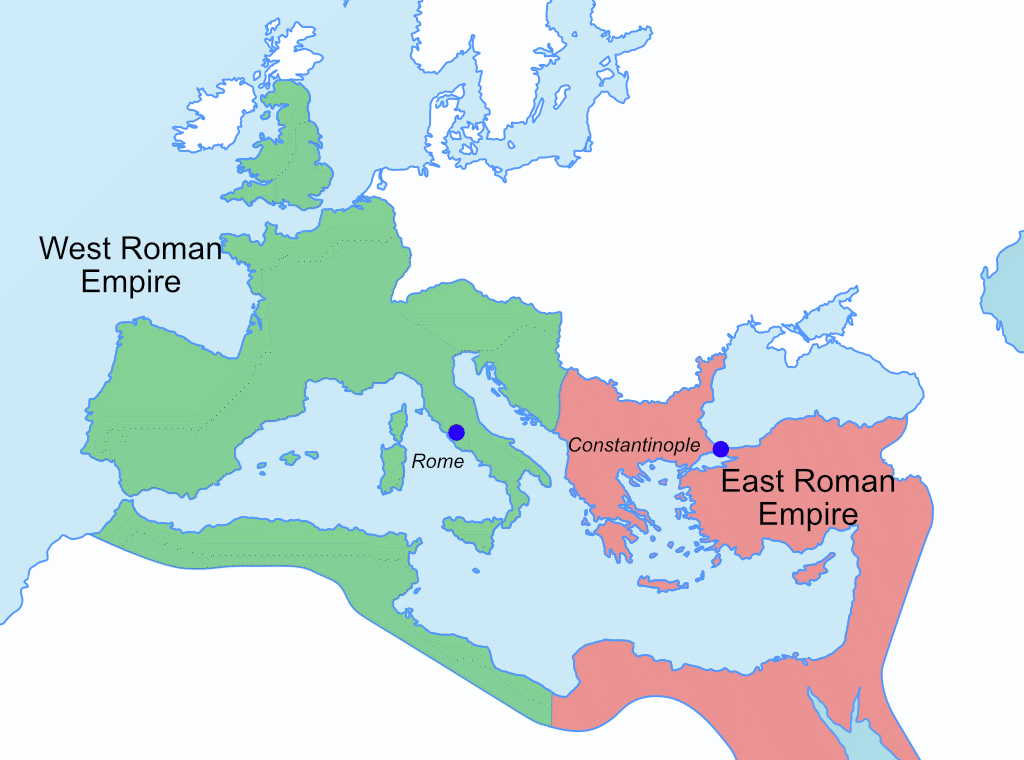
Image (altered) : AKIKA3D, CC BY-SA 4.0,
via Wikimedia Commons

Words
- according = as told by …
- advise = inform, to give an opinion
- although = while
- appoint = to choose someone for an official position
- assassinate = to murder an important person
- assembly = meeting
- border = line between two countries; here: where the empire ends
- capital = largest and most important city
- civil war = two groups of people who live in the same area or country and fight against each other
- century = a period of a hundred years
- conquer = to take control of a country by fighting
- convert = change to another religion
- decline = come down, to break apart
- defeat = to win against
- defend = guard, protect
- destroy = to completely ruin
- divide = split up
- downfall = decline, collapse
- eastward = to the east
- economically = in a way that is related to business and trading
- efficiently = here: to be well-organized
- emperor = king or queen who rules over many countries
- ever-growing = to constantly become bigger
- expand = grow, become larger
- extend = reach
- faraway = distant, very far from the centre
- fertile plains = flat area of good farming land
- force = to make someone do something
- fortification = towers and walls built around the border in order to protect and defend the empire
- found - founded = here: built
- freedom = being free; liberty
- Germanic = people with origins in the northern and central part of Europe
- govern = rule
- gradually = slowly, as time went on
- grant = give
- height = the time when it had the most power
- influence = power
- inhabitant = a person who lives in an area
- invade = to march into an area with an army in order to take control of it
- occupation = land controlled by a large group of soldiers from a foreign country
- occupy = to take control of a place with an army
- Ottomans = the Turks of the Middle Ages
- peace = time without war
- peninsula = land with water on three sides
- permanently = something that lasts for a long time
- persecute = hunt, discriminate against; to treat badly
- plunder = to steal things after you have attacked a place
- prosperity = wealth; being rich, having a high standard of living
- rival = enemy
- rule = govern
- rural = countryside
- servant = a person who works for a master
- single = only one
- slave = someone who is owned by another person and works for them for little or no money
- soldier = person who fights in an army
- sole = single, alone
- steadily = slowly
- struggle = fight
- successor = here: person who came after him as emperor
- suffer from = here: to have to deal with
- supplies = here: necessary things like food and weapons; you need them to carry out a war
- supporter = helper
- survive = here: exist
- territory = land
- throughout = in all of
- tribe = group of people who have the same language and belong to the same race
- tribune = an official in ancient Rome; elected by ordinary people to defend their rights
- troops = soldiers
- trust = here: believe
- ultimate power = here : the person who makes the final decisions
- under attack = attacked by
- vandal = someone who comes to another place and destroys buildings and other things there
- weak = not very strong