
History of New York
The first Europeans were explorers who were impressed by the area’s natural harbour. In 1609 the English navigator Henry Hudson sailed up the river that is today named after him. In 1626 the Dutch set up a trading post at the southern tip of Manhattan and called it New Amsterdam. In the same year, they bought Manhattan from the Indians who lived there.
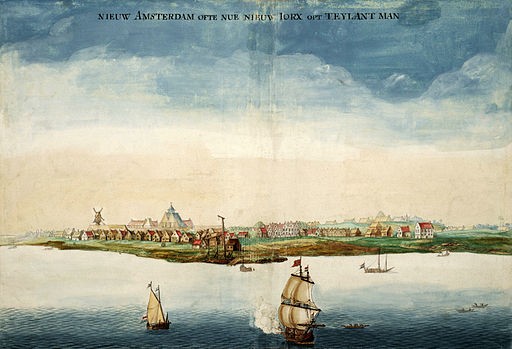
New Amsterdam in 1664
Image: Johannes Vingboons, Public domain, via Wikimedia Commons

The British took over the colony in 1664 and named it after the Duke of York. After the American Revolution, New York became America’s first capital , but only for a short time. Back then, about 33,000 people lived there.
In the early part of the 19th century, waves of European immigrants started to come to the city. They usually worked for little money, helped boost the economy and made New York the largest city in the country. The rapid growth of the city also created problems: crime, poverty, overpopulation, and pollution. In the 1970s, the city went through a big economic crisis. It didn’t have enough money to pay its bills and almost went bankrupt , but recovered again some years later.

Immigrants arriving at Ellis Island in 1902
Image: See page for author, Public domain, via Wikimedia Commons

In recent years the city has become the target of terrorist activities. In 1993 a car bomb exploded in the basement of the World Trade Centre, killing six people. The city’s darkest hour came on September 11th , 2001 when terrorists hijacked two planes and flew them into the World Trade Centre. Both buildings collapsed— the attack killed almost three thousand people. In April 2006 developers began constructing a skyscraper called Freedom Tower at the place where the World Trade Centre once stood.

United Airlines Flight 175 crashes into the south tower
of the World Trade Center complex in New York City
during the September 11 attacks
Image : UA_Flight_175_hits_WTC_south_tower_9-11.jpeg: Flickr user TheMachineStops (Robert J. Fisch)derivative work: upstateNYer, CC BY-SA 2.0,
via Wikimedia Commons
Words
- American Revolution = war in which the British colonies in America became independent
- bankrupt = when you don't have enough money to pay for the things you have bought
- basement = underground floor of a building
- bill = written list that shows how much you must pay for something
- boost = improve, make better
- capital = the main city of a country ; where the government is
- century = a hundred years
- collapse = fall apart
- developer = person who buys land and plans to build something new on it
- economic = everything related to business and money
- economy = the buying and selling of products in a country
- explorer = someone who travels to an unknown area to find out more about it
- growth = when something increases or becomes larger
- hijack = to take control of a ship or plane by using guns, knives etc..
- immigrant = someone who goes to another country to live and work there
- harbour = area of water next to land where the water is calm and ships are safe; they can load and unload goods there
- little = not very much
- navigator = here: explorer on a ship
- overpopulation = too many people live in a small space
- pollution = making air and water dirty so that you cannot use them anymore
- poverty = situation in which people are very poor
- rapid = fast, quick
- recent = in the last few years or decades
- recover = get better , improve
- skyscraper = very tall, modern building
- tip = end
- took over = started to control
- trading post = a place that was set up a long time ago at which people could buy and sell goods
- waves = groups of people