
Weather Forecasting
Scientists who study what goes on in our atmosphere are called meteorologists. They can tell us what the weather will be like in the next few days. They gather information from all sorts of instruments.
Today, weather satellites collect data from around the world. This data is entered into computers, which produce weather patterns for the future.
Ten thousand weather stations on all continents observe the weather worldwide. They use many kinds of instruments to measure the condition of the atmosphere. The thermometer, for example, measures the air temperature, a barometer measures the weight of the air and a hygrometer shows how much moisture is in the atmosphere.
Weather stations use weather radar to monitor areas of rain or snow, track storms or follow the paths of hurricanes.
Weather balloons are sent into higher regions of the atmosphere and measure changes in temperature, winds and other elements. A radio transmits data back to earth.
Weather forecasts are not always accurate, partly because humans make mistakes when they enter data, partly because the condition of the atmosphere always changes and is unpredictable.
Meteorologists can therefore predict weather over a short period of time fairly well, however long term weather predictions are very inaccurate.
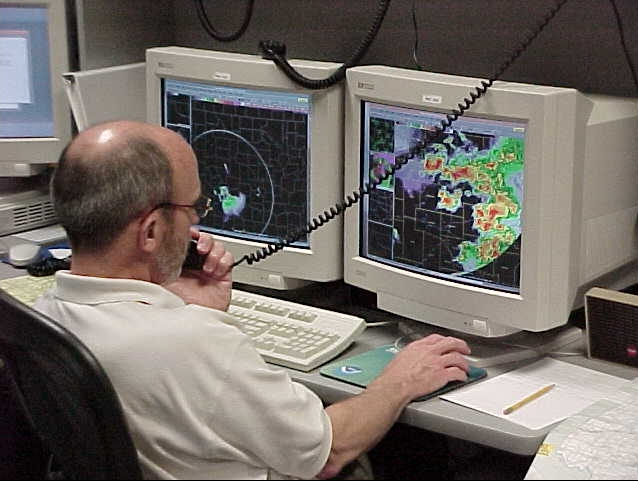
A meteorologist studying weather maps
Image: NOAA, Public domain, via Wikimedia Commons

Words
- accurate = exact, correct
- atmosphere = the mixture of gasses that are around a planet
- condition = situation
- data = information
- fairly = quite, rather
- forecast = to tell what a situation might be like in the future
- gather = collect
- however = but
- inaccurate = not exact, not correct
- measure = to find out the amount or size of something
- meteorologist = person who studies weather conditions and the climate
- moisture = small droplets of water in the air
- monitor = watch
- observe = watch, monitor
- partly = to some degree, but not completely
- path = route
- patterns = the regular ways in which things happen
- predict = foretell
- radar = machine that uses radio waves to find out where an object is
- satellite = an object that is sent into space and flies around the earth at a great height
- scientist = a person who works in a lab and carries out experiments
- sorts = kinds
- track = follow
- transmit = send back
- unpredictable = changing a lot so that you never know what will happen
- weight = how heavy something is