Cities of Australia
Sydney
Sydney is Australia's oldest and largest city, home to about 5 million people. It is Australia's most important industrial city and the capital of New South Wales . Sydney’s harbour is one of the most beautiful in the world. Harbour Bridge and the Opera House are among the famous tourist attractions.
Sydney was, at first, a prison colony back in 1788. At that time, many nations sent criminals to faraway places. The first prisoners were farmers and started raising sheep. In 1848 Great Britain stopped sending prisoners to Australia and a few years later gold was discovered . Sydney started to grow very quickly. By 1890 the population was about 400,000. During the 20th century, many European immigrants arrived and turned Sydney into a multicultural city. The people of Sydney are called Sydneysiders. About 70 % were born in Australia, but in the last few decades many Asians have come to Sydney.
Downtown Sydney has many skyscrapers and office buildings, but there are also several historic buildings and parks, in which Sydneysiders can spend their free time. Many people like outdoor activities because the city has a mild climate. Sydney offers its people long beaches that attract swimmers, surfers and sunbathers .
Sydney is a major industrial city. One third of all products made in Australia come from here. The city has a wool and food market because there are many farms nearby.
In 2000, Sydney was the host of the Olympic Summer Games. A lot of money was spent on rebuilding roads and other buildings. New stadiums were built and many parts of the city were restored and modernized.

Downtown Sydney with its famous Opera House
Image: Edward Dalmulder, CC BY 2.0, via Wikimedia Commons

Melbourne
Melbourne is Australia's second-largest city, with a population of 4.8 million. Situated around Port Phillip Bay, the city is the capital and commercial centre of Victoria. Melbourne is a multicultural city . More than a third of its inhabitants arrived as immigrants from overseas. Melbourne is the home of famous art galleries, museums and festivals. Sport events take place on a regular basis. Among the most popular are the Formula 1 Grand Prix, the Australian Open Tennis Championship and the Melbourne Cup, an annual horse race. In 1956 the city hosted the Olympic Summer Games.
Melbourne was founded as a permanent settlement in 1835 and was declared a city in 1847. When gold was discovered in the 1850s, Melbourne's rise as the centre of southern Australia started. It soon became Australia's largest city, but was eventually overtaken by Sydney. When Australia became independent in 1901 , Melbourne became the temporary capital until Canberra was completed.
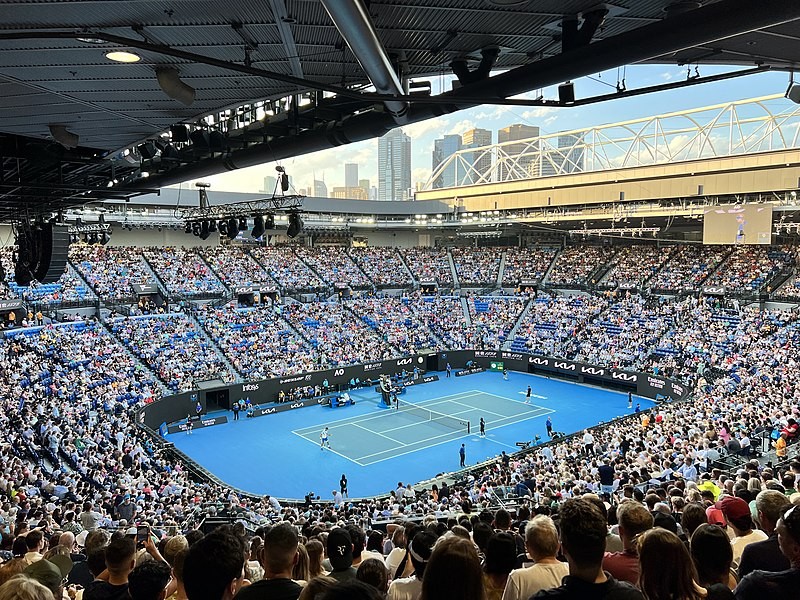
Rod Laver Arena in Melbourne
Image : Gracchus250, CC BY-SA 4.0, via Wikimedia Commons

Canberra
Canberra, with a population of about 300,000 is Australia's capital. The city is built around many hills. A dam on the Mongolo River forms Lake Burley Griffen in the middle of the city.
Australia’s parliament meets at Canberra. Many government buildings and other offices are situated here too. About half of the city’s people work for the government. Others work in smaller industries, trade and tourism.
When Australia became independent in 1901, the new government started looking for a place to build the capital city. In 1913 construction began and in 1927 Canberra became Australia’s capital.
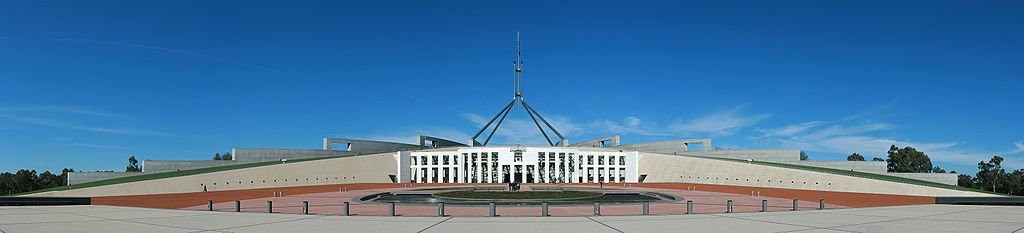
Parliament House in Canberra
Image: John O'Neill , GNU Free Documentation License Version 1.2
Brisbane
Brisbane, on Australia's eastern coast, is the capital of Queensland and, with a population of 2.5 million, Australia's third-largest city. It got its name from the river that flows through it. In its early days, some of the first prisoners were transferred there from Sydney.
Today, the city profits from its moderate climate all year long and is an attraction for people seeking outdoor activities. Although it does not lie directly on the coast, wonderful beaches are only a few kilometres away.

Skyline of Brisbane
Image: Kgbo, CC BY-SA 4.0, via Wikimedia Commons

Perth
Perth is the largest city in western Australia, and , with a population of 2 million, Australia's fourth-largest city. Because it is thousands of km away from other major cities, Perth is one of the most isolated in the world.
The city became important during Australia's gold rush towards the end of the 20th century. As time went on, western Australia turned out to be rich in minerals. Since World War II, Perth has become the headquarters for major mining companies.

Perth
Image: Dietmar Rabich / Wikimedia Commons /
“Perth (AU), View from Kings Park -- 2019 -- 0435-42” / CC BY-SA 4.0
,_View_from_Kings_Park_--_2019_--_0435-42.jpg)
Adelaide
Adelaide is the capital of South Australia and, with 1 million inhabitants, Australia's fifth most populous city. Founded in 1936, Adelaide is the only city in Australia that was made for free settlers and not for British prisoners.
Today is a multicultural city, often regarded as the food, wine and festival capital of Australia. It also offers parks, beaches and nearby hills for various outdoor activities .
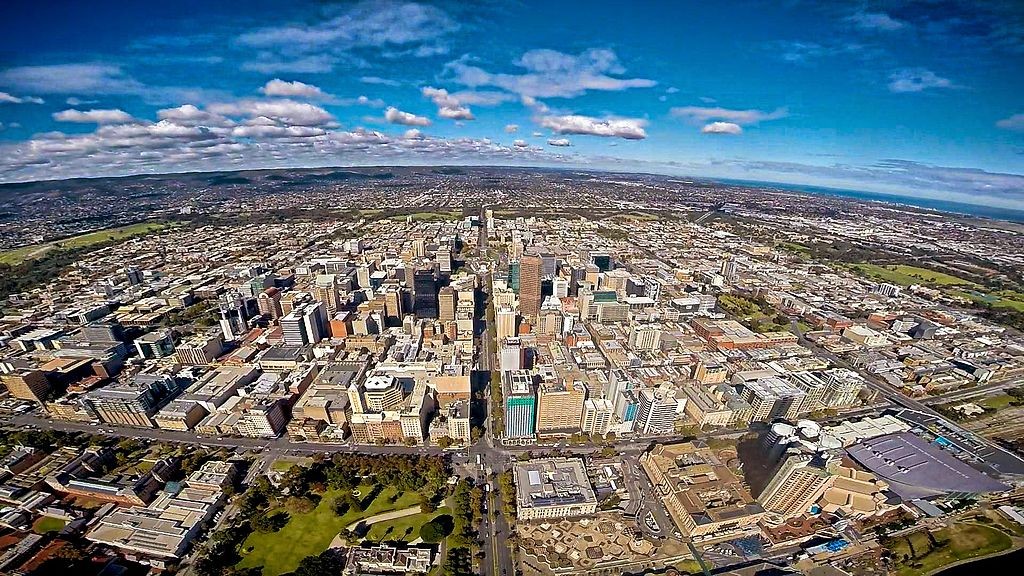
Adelaide
Image:Trentino Priori, CC BY-SA 3.0, via Wikimedia Commons


Cities in Australia
Source: https://commons.wikimedia.org/wiki/File:Australia_location_map.svg
Image modified

Words
- activities = things to do in your free time
- although = while
- annual = yearly
- attraction = something interesting for tourists to see
- capital = (1) the city or town where the government meets
- capital = (2) the main city of a region
- century = a hundred years
- complete = finish
- coast = place where land meets the sea
- construction = building
- criminal = a person who has done something that is against the law
- dam = strong wall built across a river to hold back water
- decade = ten years
- discover = to find something for the first time
- eventually = as time went on
- found - founded = to start something new; create
- gold rush = time during which gold was discovered and people hurried there to get rich
- government = the people who rule a country
- headquarters = the main building or offices of a company
- host = organize an event
- immigrant = a person who goes to another country to live and work there
- independent = free from other countries
- inhabitants = the people who live in a country or city
- isolated = far away from others
- major = important
- mineral = valuable rock that you dig out of the ground
- mining = the work of digging coal, gold or other raw materials out of the ground
- moderate = not too hot and not too cold
- most populous = with the most people living there
- multicultural = people from many nations and cultures live together
- overseas = from other continents
- population = the people who live in a city
- prison = a building where people who have done something against the law are kept
- prisoner = person who is locked up in a place and cannot get out
- profit = here: the good side of ...
- raise = to look after and feed animals, so that you can sell their products
- regarded = thought to be
- regular basis = here: very often
- rise = come up ; start to grow and become important
- seek = look for
- settlement = a new town built for people who start living in an area
- settler = person who moves to a place where not many people have lived before
- situated = located
- skyscraper = very high building with many floors
- sunbather = a person who likes to lie in the sun and get a tan
- temporary = for a short time
- trade = the buying and selling of goods
- various = different