
Life in the Middle Ages
In the Middle Ages, most people lived on a manor . It was a village with a castle, a church, and some land around it. The king gave land to his most important noblemen and bishops ,who promised to give the king soldiers for his armies.
The lowest people of society were the peasants . They didn't have their own land, but they got land from the lords . The lords also gave them protection . In return, peasants had to fight for them. This was called the feudal system.
Peasants worked on the land and produced the goods that the lord needed. But they did not lead a very nice life. They had to pay a lot of taxes and give the lord much of what they harvested . The peasants did not even "belong“ to themselves. When they did something wrong, they were often punished by their lord or by the church. Some were good craftsmen who built the things that everybody needed. They made cloth , jewellery and, very often, repaired things that were broken.
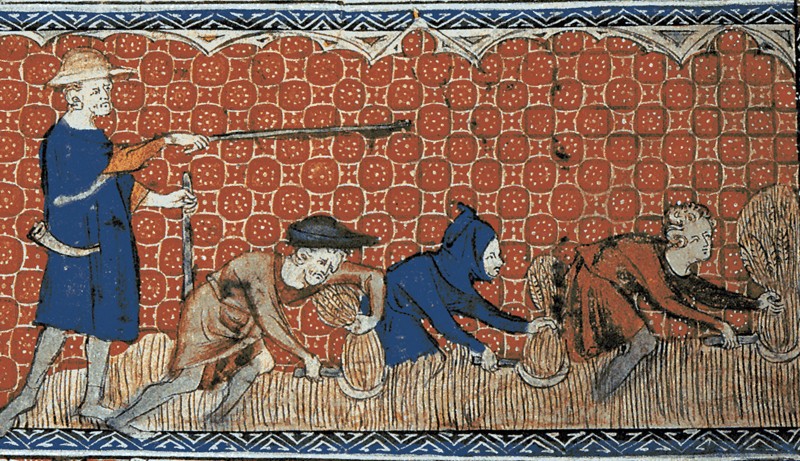
Landowner and peasants harvesting wheat
Image: anonymous (Queen Mary Master), Public domain, via Wikimedia Commons

Women
Women led a very difficult life in the Middle Ages. They did housework like cooking, baking bread, weaving and spinning . They fought in battles and learned to use weapons to defend their homes and castles.
Some medieval women had other jobs . There were women who worked as blacksmiths and merchants , while others worked in the fields or played musical instruments and danced for the king.
Some women were known as witches , who could do magic and heal other people. Many of them were burned, while others became nuns and lived for God.
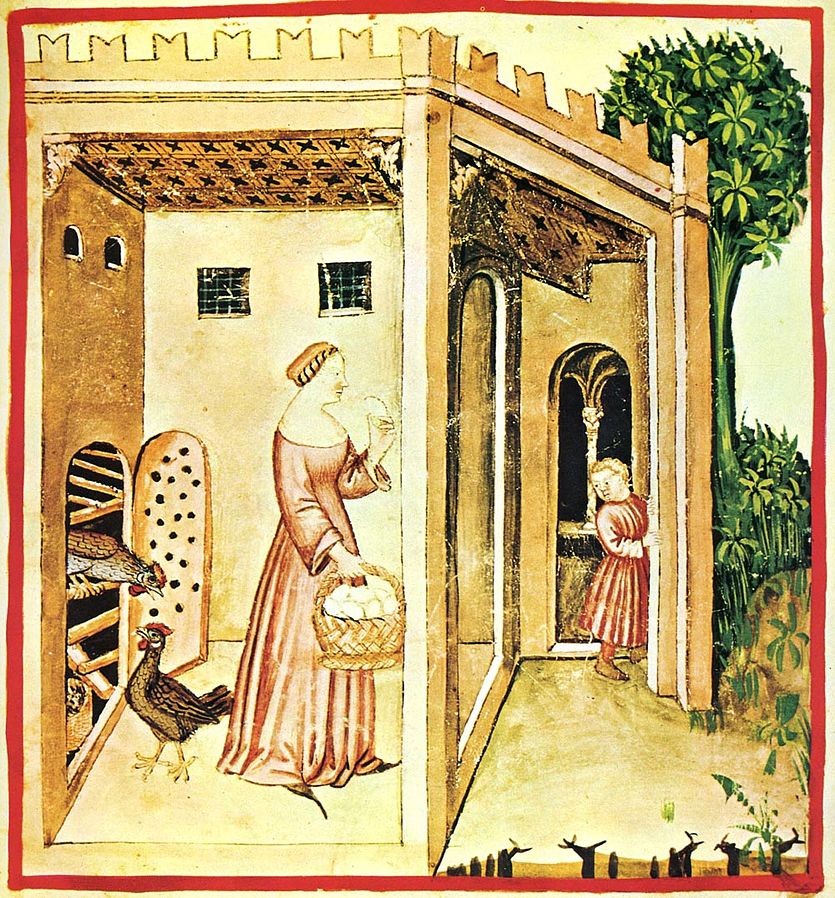
Woman collecting eggs
Image: book scan, Public domain, via Wikimedia Commons

Food
Poor people didn't get very much to eat. They had to eat dark bread because white bread was only for the king and his family. Only rich people had mutton and beef ,whereas peasants ate a lot of vegetables . People liked eating onions , garlic, and herbs that they picked from the castle garden. The best way to preserve food was to put salt on it because in those days there were no fridges. There were no plates and forks , so the food was put on flat bread, called trenchers.
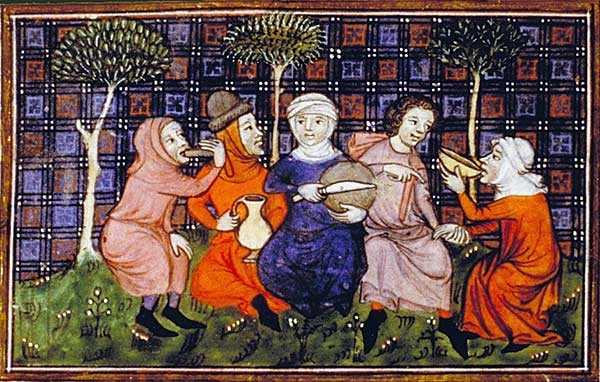
Peasants sharing a simple meal
Image: https://commons.wikimedia.org/wiki/File:Peasants_breaking_bread.jpg

Clothing
In the Middle Ages, people usually made their own clothes by spinning or weaving cloth themselves. Sometimes they bought linen to make the clothes they needed. Wool was sheared from sheep . Rich people made more expensive clothes from linen or silk.
Poor women often wore long dresses made of wool, stockings and leather shoes. The colours were very dark - brown or grey. The medieval lady wore clothes made of fine silk, wool, or fur. They were more colourful than the clothes of the poorer people. In the winter, she often wore a fur coat or a cape. Only a rich woman could afford jewellery. Shoes had wooden bottoms with leather on top of them.
Men wore tunics and trousers and later on stockings that went up their whole legs. Purple was a popular colour for men in the Middle Ages. Fur and velvet were also used a lot on the sides of coats.
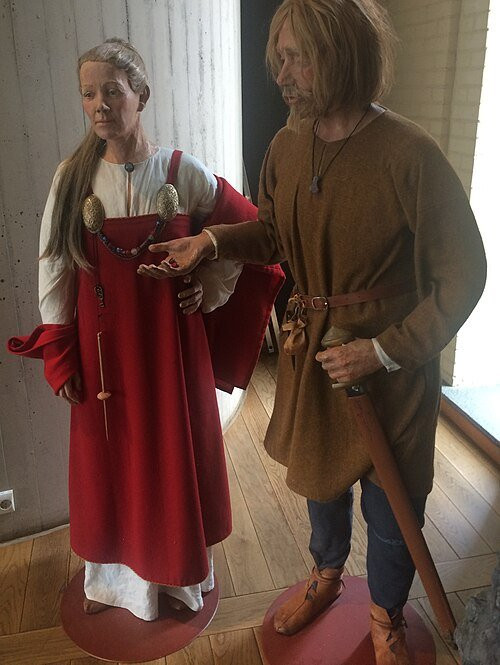
Typical Vikings clothing
Image: Wolfmann, CC BY-SA 4.0,
via Wikimedia Commons

Houses and Homes
Most medieval homes were cold, damp, and dark. Sometimes it was brighter outside the house than in it. The windows were small, because homeowners didn't want people to look into it.
Many poor families ate, slept and spent their time together in only one or two rooms. The houses had thatched roofs that could easily be destroyed.
The homes of rich people were fancier than those of the peasants. They had paved floors and tapestries sometimes hung on walls. They made the house warmer. Only the rich people had glass in their windows.
In most houses there were no chimneys. The kitchen had a stone hearth, where women cooked and kept the rooms warm. The kitchen of manor houses and castles had big fireplaces where meat and even large oxen could be roasted. Sometimes these kitchens were in different buildings because people were afraid of a fire.
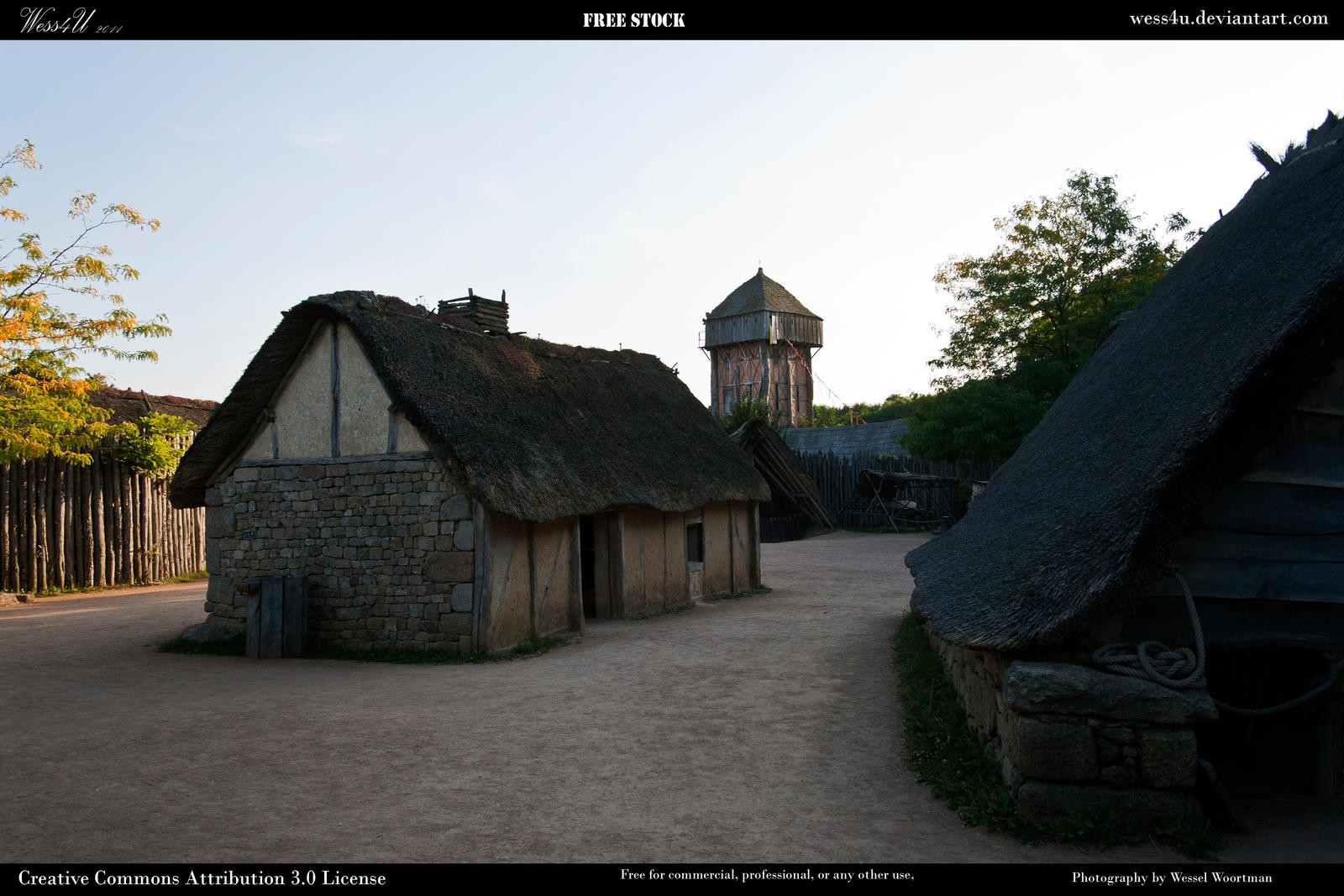
Medieval Village
Image: https://www.deviantart.com/wess4u/art/Medieval-village-4-254970968
Health
Most poor people did not have money to buy medicine, so they got ill quickly and didn't live very long. They had to help themselves .
Only the rich people got good medical treatment . Doctors cured people with the help of plants and herbs . Others laid stones on a person's body. The man who cut your hair was often the one who operated on you if you were ill .
Words
- afford = to have enough money to buy something
- battle = a fight between two armies which is a part of a bigger war
- beef = the meat of a cow
- bishop = the highest priest in the church of a certain area
- blacksmith = someone who makes or repairs objects made out of iron
- cape = a long coat without sleeves; it hangs down from your shoulder
- chimney = a pipe that comes out of the house ; smoke from a fire passes through it
- cloth = material used for making clothes
- craftsman = someone who can make things with their hands
- cure = to make someone healthy again after an illness
- damp = wet
- defend = protect
- destroy = damage something so that you cannot use it any more
- garlic = plant like an onion ; used to give food a strong taste
- goods = products
- fancier = more expensive and fashionable
- fork = a tool you use for picking up and eating food ; on one end it has 3 or 4 sharp points
- fur = thick, soft hair that covers the body of an animal
- harvest = to bring in crops from the field
- heal = to make healthy
- hearth = fireplace, oven
- herbs = small plants that are used to make food taste better — people also use them to make medicine
- jewellery = small objects made of gold or silver which you can wear around your neck or hands
- linen = cloth made from the flax plant; you use it to make high-quality clothes
- lord = very powerful and rich person in the Middles Ages ; he owned a lot of land
- manor = a big, old house with a lot of land around it ; it mostly belonged to lords and other noblemen
- medieval = about the Middle Ages
- merchant = a person who buys and sells things
- mutton = the meat of a lamb
- noblemen = people who were members of the highest class in the Middle Ages
- nun = a religious woman who lives with others in a convent
- onion = a round, white vegetable with a brown, red or white skin; onions have a strong taste and make you cry when you cut them
- oxen = a bull whose sex organs have been removed; often used for working on farms
- paved = with a hard surface
- peasant = a poor farmer who rents land from a lord
- plate = a flat dish that you eat out of
- popular = much liked
- preserve = to make something last for a longer time
- protection = when something is guarded or defended
- punish = to make someone suffer because they have done something wrong
- roast = to cook over a fire
- shear = to cut wool off sheep
- silk = thread made by a silkworm
- society = people in general
- soldier = person who fights for their country or king in a war
- spinning = to make cotton or wool into thread by twisting it
- stocking = piece of clothing that covers a person's legs
- tapestry = a large piece of heavy cloth that looks like a picture
- taxes = money that the governments collects from everyone
- thatched = made of dry grass or leaves
- treatment = something that you do to help or cure someone
- tunic = long piece of clothing, usually without sleeves
- velvet = expensive cloth that has a soft surface on one side
- village = a very small town
- weapon = an object you use to fight or attack someone with, like a knife
- weaving = to make cloth, carpets, or other things by crossing threads
- witch = a woman who is said to have magic powers and does bad things