
History of the Middle Ages
Migration Period - Tribes Invade Europe
To the north of the Roman Empire, there were people who spoke a language that is like today's German. They were called the Germanic tribes.
In the 5th century, these Germanic tribes overran the Roman Empire. The Eastern Goths came from Russia and Ukraine. They conquered most of Italy, Greece and the western Balkans. The Franks took over today's France, and the Saxons conquered the southern parts of England.
The Huns originally came from Central Asia. They overran the Chinese Empire in about 200 B.C. and the Chinese emperor had to build a great wall to keep them out. At about 400 A.D. Attila became the leader of the Huns. They came to Europe and forced other tribes to move westward.
The Huns destroyed everything that was in their way. They had no interest in the land they conquered - they only plundered and set fire to villages. When Attila died, the Huns didn't have a strong leader. In the following years, the Goths and other Germanic tribes defeated them.
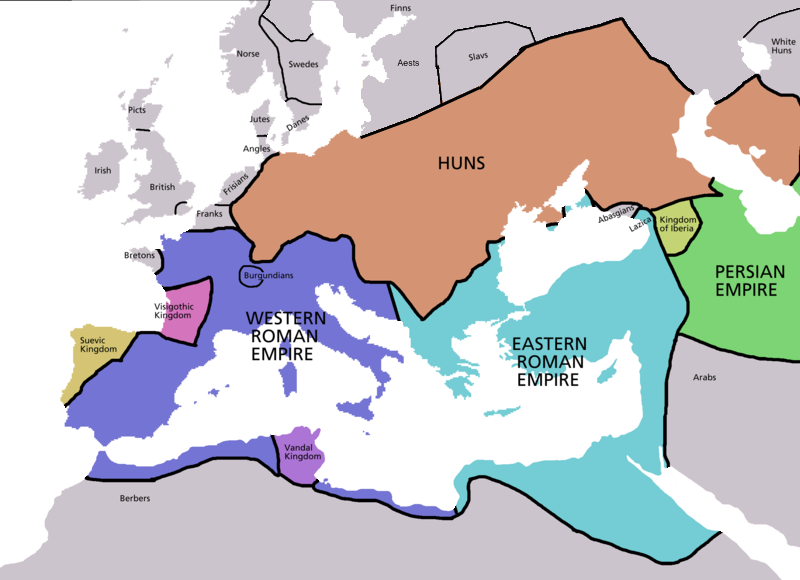
Map of Europe at around 450 A.D.
Image : CC BY-SA 3.0, Link
Rise of Islam
Islam started to become an important religion at the beginning of the 7th century. Mohammed was the main prophet of Islam. He founded and ruled the first Islamic state in the Middle East. Between 700 and 1000 A.D. Islam spread to many parts of Northern Africa and even got as far as Spain in the west and India and China in the east.
The Franks and Charlemagne
The Franks were a Germanic tribe in Western Europe that began to conquer other tribes. One of their greatest kings was Charlemagne, or Charles the Great. When he was king, the Franks invaded Spain and Central Europe. His goal was to bring together all the Germanic tribes into one Christian kingdom.
On Christmas Day 800, the pope crowned Charles the Great, emperor of the "Holy Roman Empire“. Charlemagne wanted to continue the Roman Empire in central and Western Europe.
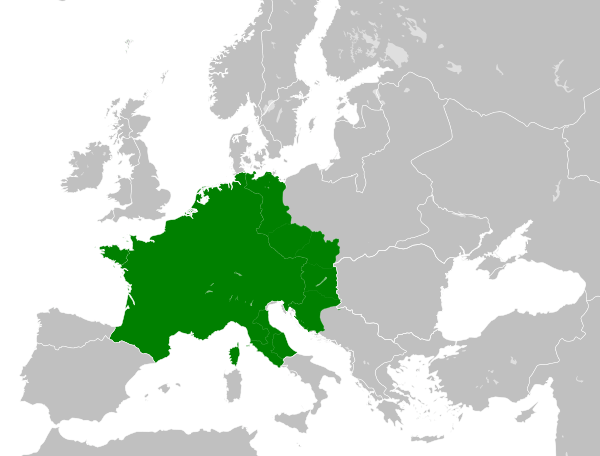
The Frankish Empire at about 814 A.D.
Image (modified) :Blank map of Europe.svg: maix¿?derivative work: Alphathon, CC BY-SA 4.0,
via Wikimedia Commons
The Vikings
The Vikings were fierce warriors that wanted to conquer Charlemagne's empire. They came from Norway, Sweden and Denmark, countries that we now call Scandinavia.
The Vikings were sailors, and they were good at building ships. A Viking ship could sail very fast, and it could hold about 100 men. These ships were very strong and powerful, and they were not very deep, so that they could also travel on rivers. The Vikings attacked lands near the sea without warning. They got out of their boats, overran villages and took as many things as they could carry with them. Then they quickly left and sailed to another place.
By the tenth century, the Vikings controlled parts of Great Britain, France and Russia and even sailed to Egypt. Other Vikings sailed west and discovered Iceland and Greenland. One Viking sailor, Leif Ericson, even got to North America. There, he founded a village in today's Newfoundland and called it "Vinland" because it was so warm that you could grow grapes there.
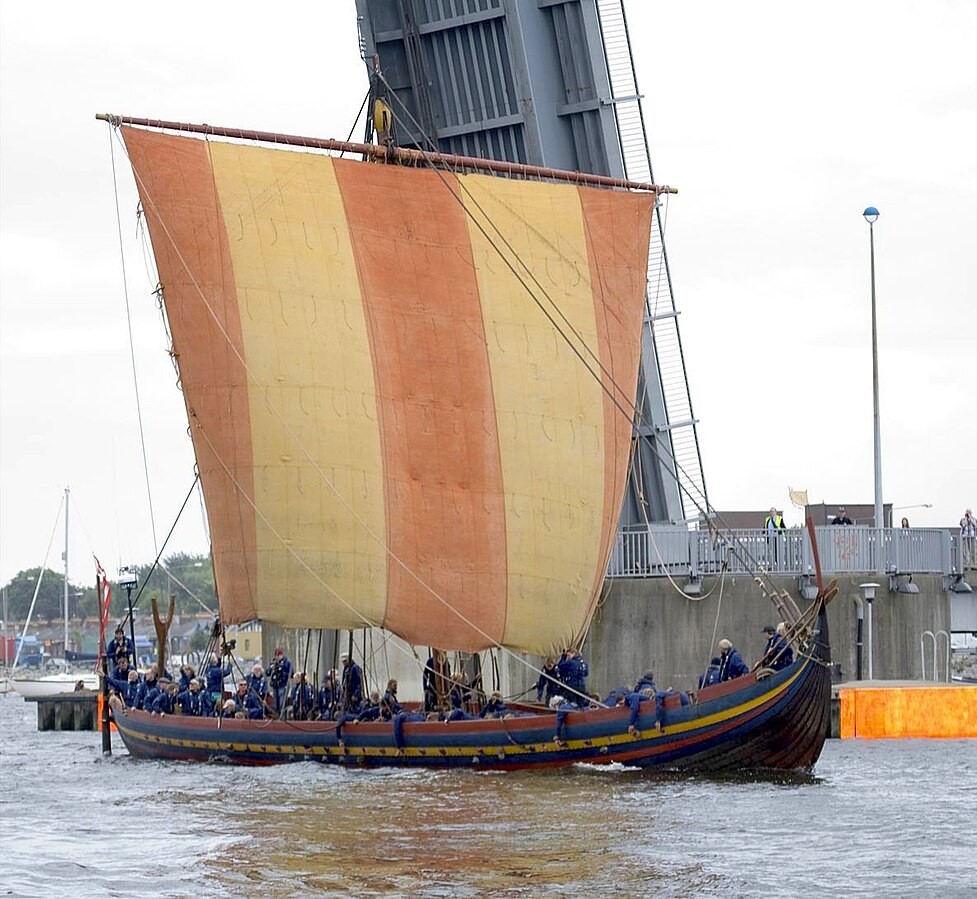
Reconstructed Viking ship
Image: William Murphy, CC BY-SA 2.0, via Wikimedia Commons
The Normans
One group of Vikings settled in Normandy, a part of north-western France. They spoke French and became Christians, but they still liked adventures.
William the Conqueror was a powerful Norman king who invaded Britain in 1066. For the next 300 years, England was ruled by kings who did not speak English.
The English hated the Normans, and the two countries became enemies for the next centuries. William built a lot of castles and buildings and paid for his projects by collecting taxes from the English people. The Normans brought a lot of French words to England. They also took over the lands of English lords and built the Tower of London.
The Crusades
The Crusades were wars that were fought by Christians against Muslims. The Turks and other Muslims took control of Jerusalem and the Holy Land in the 11th century. The Muslims forbade Christians to come to Jerusalem and pray.
In 1095 Pope Urban got together many soldiers and knights and sent them to Jerusalem to free the city from the Muslims. The French, Germans and Italians were the first European Christians to go on Crusades. The word “ crusade” meant "war of the cross". Pilgrims also went to Jerusalem to pray there.
During the first Crusade, many knights died of hunger, thirst and disease. When they got to Jerusalem, they killed anyone they could find.
Some knights took foot soldiers with them. They helped carry things for their masters. When the soldiers got to Jerusalem, they tried to get into the city by using huge weapons, called ballistas. They were big catapults that shot large stones and other things over big walls. Other knights tried to dig tunnels and then set fire to the walls. When the knights got inside the city, they killed everyone they could see.
The Crusades didn't really achieve much for the European Christians. Soldiers and knights captured the Holy Land back for a few years, but then lost it to the Muslims again. But the Crusades were important for Europe. Many castles were built, and new religious orders were founded.
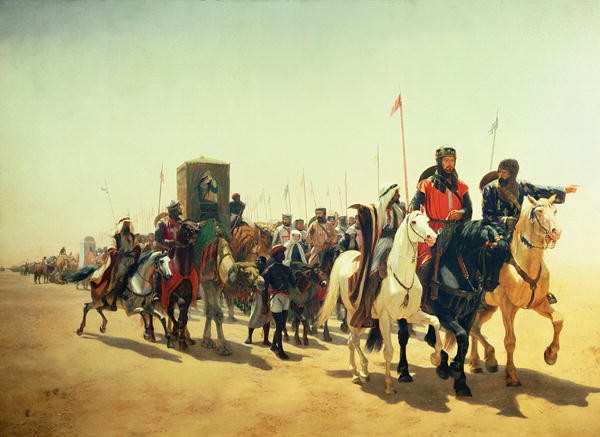
Richard the Lionheart on his way to Jerusalem
Image:By James William Glass - http://www.1st-art-gallery.com/James-William-Glass/Richard,-Coeur-De-Lion,-On-His-Way-To-Jerusalem-%28richard,-The-Lion-Heart,-On-His-Way-To-Jerusalem%29.html, Public Domain, Link
Joan of Arc
|
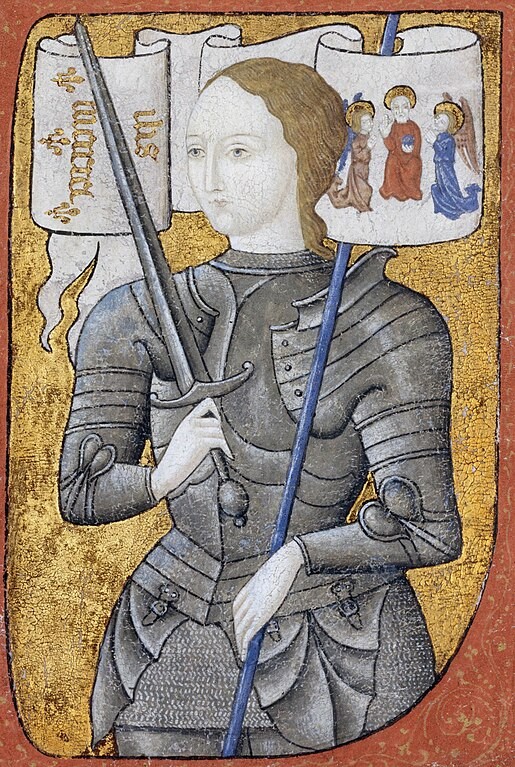
Joan of Arc was one of France's most famous women. She became a saint and was also called the" Maid of Orleans". She came from a very poor family. When Joan was 13 she believed she heard voices from God. Sometimes she also saw visions from heaven. When the British were about to capture Orleans in the Hundred-Year War, these voices told her to help Charles VII, who later became King of France. In the Battle of Orleans, Charles gave her soldiers and with them, she was able to beat the English. After Charles became king, Joan went on to fight against the English on her own. But Charles wanted to have peace with the English king. When the English captured her, they turned her over to the French king. She was burned at the stake, because Charles and his supporters thought that she was a witch. |
Joan of Arc |


Black Death
Almost half of the people in Western Europe died of a great illness that was called the "Black Death". It got its name because the skin of the sick people turned dark and grey.
The Black Death probably began in China, where it killed about 35 million people. When sailors travelled to Asia, rats returned with them. Fleas sucked their blood and spread the disease to most of Europe.
In the middle of the 14th century, merchant ships returned from Asia and many sailors were already dying of the plague. Within days, it spread to all big cities and the countryside.
Death came very quickly. The first signs were aching arms and legs, and many people vomited blood. Faces often became swollen and the skin colour turned dark. Most victims had terrible pain. Many people died within 24 hours after they got the disease.
The disease could spread quickly because there was not enough medicine in those days and people often ate rotten meat.
The people of the Middle Ages thought that the "Black Death“was a sign of punishment from God. Today we have a cure for this disease, but it still happens in very poor countries of the Third World.
Words
- ache = hurt
- achieve = reach a goal
- attack = to damage and destroy places
- battle = fight in a war
- beat = to win against
- capture = to take control of
- catapult = a large weapon used a long time ago to throw stones and balls over a wall
- century = a period of a hundred years
- conquer = to invade a country with soldiers and take control
- continue = to go on with
- crown = to make someone king or queen
- Crusades = eight wars that European kings led in the 11th, 12th and 13th centuries to get control of Jerusalem and the Holy Land
- cure = treatment; something to make an illness go away
- defeat = to win against
- destroy = to damage something so that you cannot use it any more
- dig = to make a hole into the earth
- discover = to find a place for the first time
- disease = illness
- emperor = the person who controls an empire
- empire = a group of countries controlled by one king or queen
- enemy = someone you fight against in a war
- fierce = very violent, brutal, terrible
- flea = very small insect without wings that bites animals and people and sucks out their blood
- foot soldier = a soldier who helps a knight and usually travels on foot
- forbid - forbade = not allow
- found - founded = to start something new
- force = to make someone do something
- goal = aim, what you want to do
- grapes = small round green and purple fruits that you use to make wine
- huge = very large
- illness = disease
- invade = to enter a country with an army and take control of it
- kingdom = a group of many countries ruled by a king or queen
- knight = a man with a high rank who lived in the Middle Ages and fought on horseback
- lord = a man in the Middle Ages who usually had a lot of land and was very powerful
- maid = woman or girl who is not married
- main = most important
- merchant ship = a ship that has goods and products on board and travels from one continent to another
- Muslim = a person whose religion is Islam
- on her own = by herself
- order = a religious group that lived by certain rules
- originally = at first
- overrun = to take control of a place with an army
- pain = the feeling you have when your body hurts
- peace = a time without war
- pilgrim = a religious person who travels a long way to a holy place
- plunder = to steal things from a place you have conquered
- pope = leader of the Roman Catholic Church
- pray = to say words to God
- prophet = a man who people believe has been sent by God in order to lead them
- punishment = to make someone suffer because they have done something wrong
- rotten = something that you can no longer eat because it is old
- rule = govern
- sailor = a person who works on a ship
- saint = someone who gets a title from the church after they have died because they had done good things
- settle = to live in a place for the first time
- soldier = member of an army who fights in a war
- spread = to move from one place to another
- stake = a long post used to tie people against
- suck = to pull out with your mouth
- supporter = friend, helper
- swollen = very thick and red
- tax = money you collect from the people and use for many things in a country
- tribe = a group of people of the same race who have the same traditions and customs
- turn her over = give her back
- victim = here: person who has an illness
- vomit = when food or liquid comes back from out of your stomach through your mouth
- warrior = a brave soldier of the past
- weapon = something you use to fight in a war
- witch = a woman who has magical powers