
India's Population Problems
People with different cultures and languages have been living together in India for thousands of years. While there are hundreds of different languages on the subcontinent, the official language is Hindi, while most people speak English too. About 80% of the Indian population is Hindu. Muslims are the biggest minority.
Today, India is the home to over 1.4 billion people. It has surpassed China as the most populous country in the world. Experts think that India will reach a total of 1.8 billion before population growth begins to decrease. In contrast to China’s one-child policy, family planning in India has not been consistent. In the 1970s and 80s, the government tried to control population growth by forcing people to have sterilizations. Today, however, there are signs that population growth is slowing down. Contraception is becoming widely available in many areas, and especially Indian women in rural areas are becoming more educated.
Every Indian woman has almost 3 children, compared to a little over one child per family in the west. As in many Asian societies, children are needed to do work and care for family members when they get older. Boys are more valuable than girls, who marry at an early age. About a third of India’s population is under 14, which makes it one of the youngest countries on earth. Apart from that, India still has the largest proportion of people who cannot read and write.
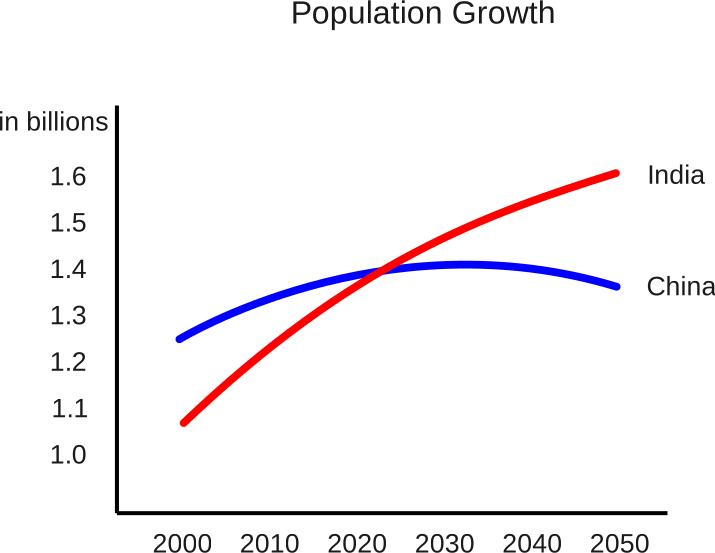
Indian population compared to China
Image: own work
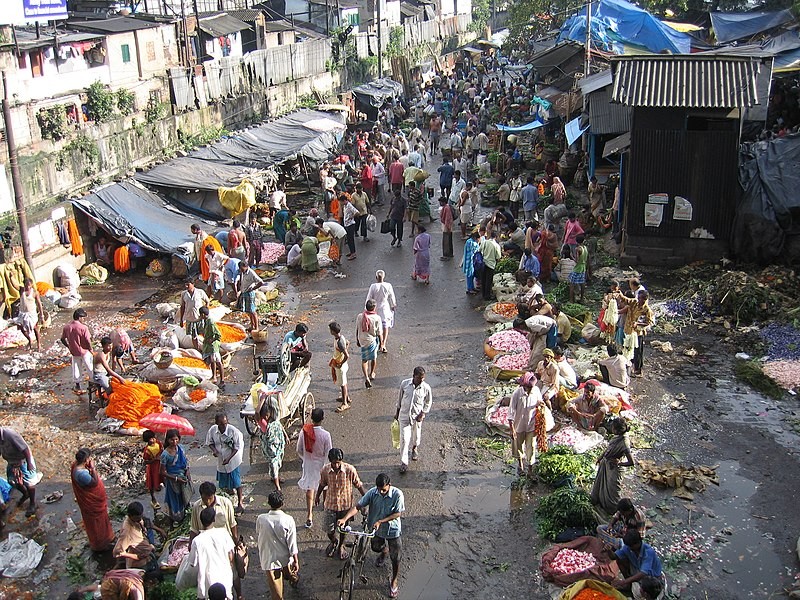
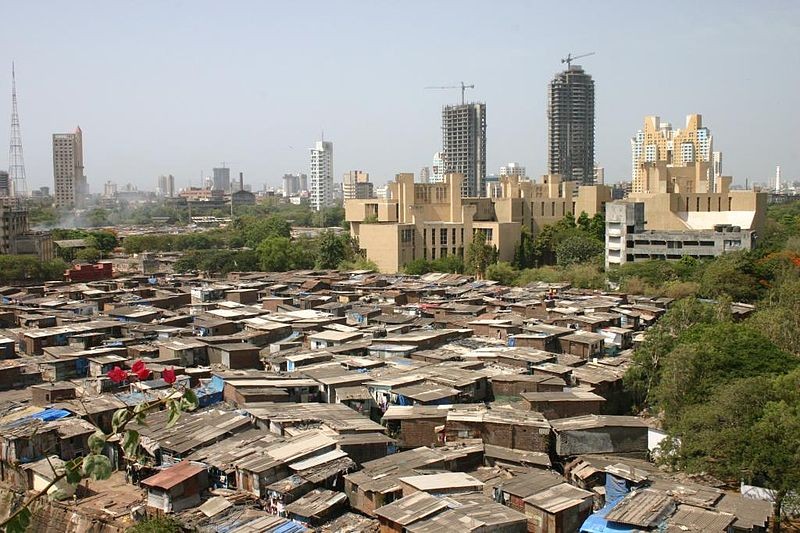
More than 70% of Indian people live in the countryside, in smaller villages and towns. As the rural population is becoming poorer, more and more people are moving to the big cities where they live in overcrowded slums with no electricity or clean water. As a result, cities like Mumbai, Calcutta and New Delhi are exploding with people they have no jobs for.
Overpopulation in India is causing even more problems. An increasing population living on the same land will quickly use up the limited resources the country has. Medical conditions are getting worse and diseases are spreading faster. More and more Indians are living below the poverty line.
|
Flower Market in Calcutta |
Slums in Mumbai |


Words
- billion = 1,000,000,000 = one thousand million
- cause = lead to
- consistent = always happening in the same way
- contraception = methods of stopping a woman from having a baby; birth control
- decrease = go down
- disease = illness
- electricity = power that is transported in wires and cables; it is used to give us light and heat or to make machines work
- especially = above all
- family planning = controlling the number of children that are born
- force = to make someone do something
- government = the people who rule a country
- in contrast to = compared to ; something that is different
- increasing = growing
- limited = ending, not lasting forever
- medical conditions = health care, doctors, hospitals etc...
- minority = small group of people within a much larger group
- most populous = with the most people
- population growth = when more and more people live in a country
- official = here: used by the government
- one-child policy = every family is allowed to have only one child
- overcrowded = with too many people
- overpopulation = when too many people live in a small area
- poverty line = situation in which a person does not have enough money to buy the things they really need
- proportion = share, number
- resources = raw materials
- rural = the countryside
- sterilization = an operation that stops a man from producing and a woman from getting babies
- subcontinent = part of a continent
- surpass = overtake, be bigger than
- valuable = worth a lot
- widely available = here: can be bought in many places