Results and Aftermath of World War II
After the end of the war, a conference was held in Potsdam, Germany, to set up peace treaties. The countries that fought with Hitler lost territory and had to pay reparations to the Allies. Germany and its capital Berlin were divided into four parts. The zones were to be controlled by Great Britain, the United States, France and the Soviet Union. The three western Allies and the Soviet Union disagreed on many things and as time went on Germany was divided into two separate countries: East Germany , which had a Communist government and West Germany, which was a democratic state . Berlin was divided into East and West Berlin. Austria was also occupied by the four Allies from 1945 to 1955.
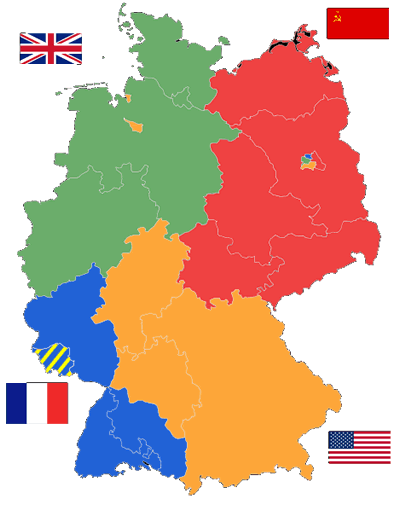
German occupation zones after World War II
Image: svg version created by glglgl, CC BY-SA 3.0,
via Wikimedia Commons

One by one, the Russians started to take over countries in Eastern Europe and install Communist governments there. The division of Europe was the beginning of the Cold War, between the democratic nations of the west and the Communist countries of Eastern Europe. The Iron Curtain marked the border between these two regions.
After the war, many Nazi leaders were arrested and punished for what they had done in the war. The most famous war trials were held at Nuremberg, Germany. Those who were responsible for brutal crimes were sentenced to death.
Many problems arose after the war was over. One of them focused on the city of Berlin, which was deep inside the Russian zone. In June 1948, the Soviet Union tried to drive the western powers out of Berlin by blocking all routes to the city. For a whole year the Allies flew in food, fuel and other things that the population needed to survive. Finally, the Russians gave up and the blockade ended. In 1961 the East Germans built a wall around Berlin to stop their citizens from escaping to the west.
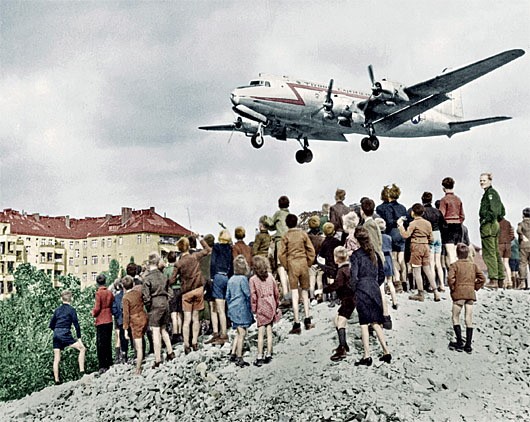
Berlin citizens watch American plane land at Tempelhof Airport
Image: USAF, Public domain, via Wikimedia Commons

The biggest task was to rebuild Europe, which lay in ruins. In 1948 the United States set up the Marshall Plan to help Europe’s economy. 18 nations received 13 billion dollars worth of food, machines and other goods.
During World War II, four of the Allied powers—the United States, Great Britain, the Soviet Union and China— agreed to create an organization that should work for peace . In April 1945 fifty countries signed a charter and gave birth to the United Nations.
Words
- Allies = the countries that fought against Germany and Japan in World War II (the Soviet Union, Great Britain, France and the United States)
- arise - arose = come up
- arrest = to take a person to the police station because they may have done something wrong
- billion = a thousand million
- blockade = to stop people or products from entering a country
- border = here : line between two different political systems
- charter = set of rules that countries agree on
- citizen = a person who lives in a country and has rights there
- disagree = to have different opinions
- divide = split up
- economy = the system of buying and selling goods in a country
- escape = get away from something dangerous
- finally = in the end
- focus = concentrate on
- fuel = coal, gas or oil that can be burned to make heat
- give birth = here: to start an organization
- goods = things that are produced so that they can be sold
- government = the people who rule a country
- install = set up
- mark = to be a sign of
- occupy = when you control a foreign country with soldiers
- peace treaty = countries agree not to attack each other and write it down on paper
- punish = to make someone suffer because they have done something wrong
- rebuild = build up again
- receive = get
- reparations = money that a country which loses the war has to pay for all the damage and deaths that it caused
- responsible = to blame someone for something
- routes = here: roads, railway lines, canals, rivers
- ruins = what is left of a building or structure
- separate = single, independent
- sentence = the punishment that a judge gives a person
- set up = organize
- sign = to put your name on a document
- survive = exist, live
- take over = start to control
- task = job, mission
- territory = land
- war trials = people who are responsible for war crimes are put before a court