
Operation Barbarossa - The German Invasion of the Soviet Union
Although Adolf Hitler conquered many western European countries during the first years of the war, he saw the Soviet Union as his main enemy. He was afraid that the Russians would expand towards Central Europe, and he also wanted to control the Soviet wheat and oil fields. Hitler signed a treaty with dictator Joseph Stalin in 1939 that would keep the Soviet Union out of the war while he overran Western Europe.
On June 22, 1941 Germany started Operation Barbarossa—the invasion of the Soviet Union. The attack surprised the Soviets, and German tanks smashed through the Russian battle lines. In the first few weeks, hundreds of thousands of enemy soldiers were captured. As the Germans went forward, the Soviet population destroyed factories, dams, railroads, food supplies and other things that might help the Germans. The Germans were heading for a fast victory, but then they started making mistakes.
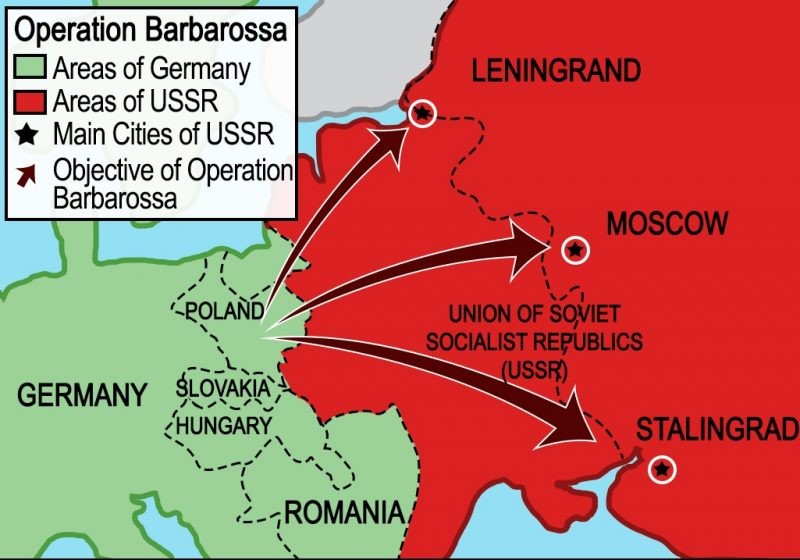
Germany attacks the Soviet Union
Image: Dhammika111, CC BY-SA 4.0, via Wikimedia Commons

Hitler's generals wanted to capture Moscow before the winter started, but Hitler himself had a different plan. He ordered the German army to wait until new forces came to help them. This gave the Soviets time to strengthen their army. By December 1941 the Germans had surrounded Leningrad and were in the suburbs of Moscow. But then a harsh winter set in early and temperatures dropped to –40°C. German troops did not have enough clothing, and many soldiers suffered from frostbite. Tanks and other weapons broke down in the bitter cold. The Russians started a counterattack and the German army had to retreat.
Although Hitler had lost many soldiers and a lot of Russian territory, his army was still strong enough to continue fighting. In the summer of 1942, he turned his attention to the Caucasus, an oil-rich mountainous region in southern Russia. In August, Hitler attacked Stalingrad. It was the biggest battle of World War II. German artillery destroyed the city, but the Russians defended it with what they had left. When winter began, they counterattacked and drove the Germans back. After having lost more than 200,000 men, the German army surrendered at the end of January 1943. The defeat was the worst that Nazi Germany suffered, and Stalingrad became a turning point in the war.
The Germans had to withdraw from the Caucasus and as time went on the Soviets drove them out of their whole country. From this point on, the Russian army got stronger and stronger and started their march towards the west.
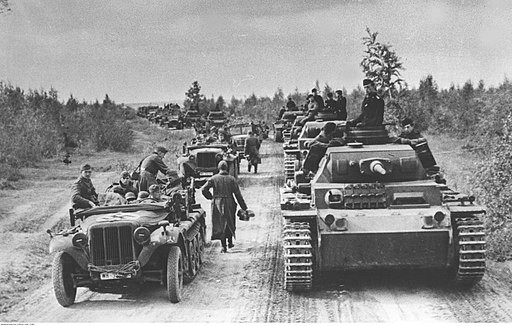
German tanks advance towards Moscow
Image: Narodowe Archiwum Cyfrowe, Public domain,
via Wikimedia Commons
.jpg)
Words
- artillery = large guns that are moved on wheels or fixed in a place
- attention = concentration , interest
- battle = fight between two armies in a war
- battle line = the line that separates two fighting armies
- capture =
- to catch a person and keep them as prisoner
- take control of
- clothing = things to wear
- conquer = to take control of land by fighting
- counterattack = an attack against someone who has attacked you in a war
- defeat = loss
- defend = protect, guard
- drop = to go down
- drove them out = made them get out
- factory = place where products are made with machines
- food supplies = the food that people need to survive
- forces = soldiers
- frostbite = when it is very cold and your fingers and toes swell and become darker; sometimes they even fall off
- enemy = here: the country you are fighting against
- expand = to grow; get bigger
- harsh = very bad and difficult to survive in
- heading for = here: on the way to reach something
- invasion = when an army of a country enters another country and takes control of it
- main = here: largest
- mountainous = with many mountains
- population = the people of a country
- retreat = to move back
- sign = to put your name on a document
- smash = here: to break through very fast
- soldier = a person who fights for their country in a war
- strengthen = to make stronger
- suburb = an area of the city which is farther away from the center
- suffer = to feel pain
- surrender = to give up
- surround = to be around a place from all sides
- tank = a heavy military car that moves on a metal belt; it has a large gun on its top
- territory = land
- towards = in a direction
- treaty = a written document between two people or countries
- turning point = here: the time when one army starts winning battles and the other starts losing them
- victory = win
- weapon = objects that you use to fight against someone, like a gun, knife or a bomb
- wheat = food plant that white bread is made from
- withdraw = move back