The Blitzkrieg and The Battle of Britain
The Blitzkrieg
On September 1, 1939 Germany invaded Poland and World War II began. At the same time, the Soviet Union attacked Poland from the east. It was divided among the two countries before the Allies were able to help.
Germany's attack was carried out with fast tanks and troops that were supported by warplanes. Because the German army moved very quickly, this phase of the war was called "Blitzkrieg".
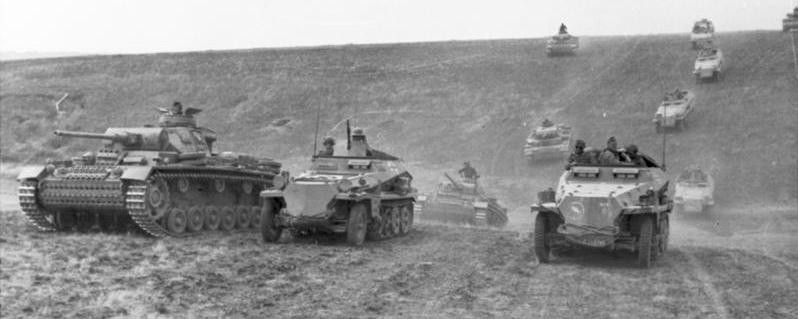
German tanks and other vehicles during the Blitzkrieg
Image: Bundesarchiv, Bild 101I-218-0504-36 / Dieck / CC-BY-SA 3.0, CC BY-SA 3.0 DE, via Wikimedia Commons
.jpg)
In the following spring, Germany invaded Norway and Denmark. Both countries were occupied by the German army by June. On May 10, 1940 Hitler's troops invaded the Low Countries- Belgium, the Netherlands and Luxembourg and days later they surrendered.
In the middle of May German soldiers crossed into France and by June 14 the Germans had entered Paris. On June 22 France signed a peace agreement with Germany. German forces then occupied northern France and the Atlantic coast. A new government that was friendly to the Germans was formed in Vichy. On the other side, General Charles de Gaulle escaped to Great Britain and started his free French movement. In radio broadcasts, he urged the French people to fight against the Germans.
The Battle of Britain
Hitler next wanted to invade the island of Great Britain. He attacked the British Air Force in order to control the skies over the island. It was history's first major air battle.
In June 1940, the German Luftwaffe began bombing airfields and other targets in southern England. German warplanes attacked from airports in France. At the end of the battle the British had shot down about 1700 German planes. Hitler saw that he could not defeat England's air force , so he gave up his idea of invading Britain. Instead, he sent the Luftwaffe to bomb British cities and towns. In London alone, more than 12,000 civilians were killed.
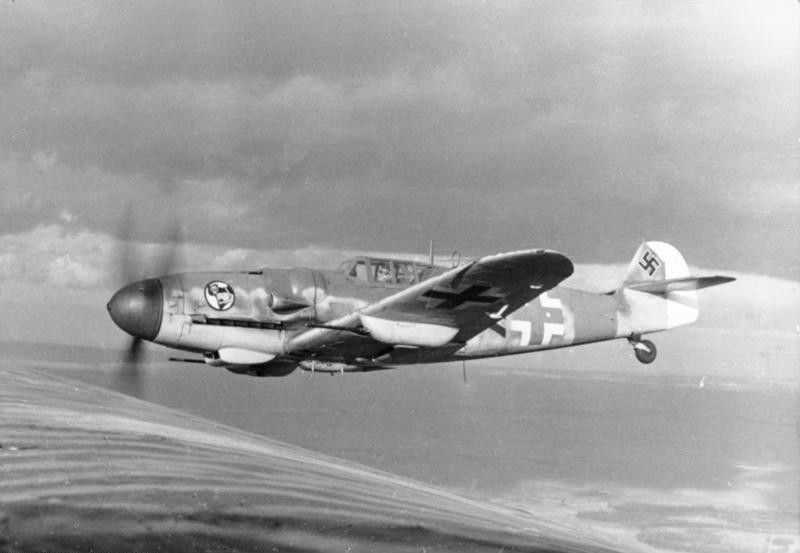
German Messerschmitt bomber during the Battle of Britain
Image: Bundesarchiv, Bild 101I-662-6659-37 / Hebenstreit / CC-BY-SA 3.0, CC BY-SA 3.0 DE,
via Wikimedia Commons

Words
- airfield = a smaller airport where military airplanes take off and land
- air force = the planes that fight for a country
- Allies = the countries that fought against Germany and Japan in World War II ( the United States, France, Great Britain and the Soviet Union)
- attack = to use weapons against an enemy in a war
- civilian = person who is not a soldier
- battle = fight in a war
- defeat = win against
- divide = split between
- escape = to get away in a dangerous situation
- forces = soldiers
- government = the people who rule a country
- instead = here: to do something else
- invade = to enter a country with an army and take control of it
- major = important
- movement = group of people who believe in the same things and have the same ideas
- occupy = march into another country and stay there for a longer period of time
- peace agreement = when two countries promise not to attack each other
- radio broadcast = a program on the radio
- sign = to put your name on a document
- support = help, assist
- surrender = to give up
- tank = a heavy military car that moves on a metal belt; it has a large gun on its top
- target = object you want to attack
- troops = soldiers
- urge = persuade ; to ask someone to do something that is important