
The Ozone Layer
The ozone layer is a thin shield of gases that is located in Earth’s atmosphere, about 15 to 30 km from the surface. It is vital for life because it protects us from the sun’s dangerous ultraviolet (UV) rays, which can cause skin cancer and harm animals and plants.
Although the ozone layer was first discovered by two French scientists in the early 20th century, it worked perfectly for decades. However, in the 1980s, scientists became aware of a big problem. They discovered that the layer was getting extremely thin over Antarctica. This became known as the “ozone hole”.
The main reasons for the damage to this part of the atmosphere were man-made chemicals, especially chlorofluorocarbons (CFCs). For years, people used CFCs in everyday products like refrigerators, air conditioners, and spray cans. When these chemicals escaped into the air, they traveled up to the atmosphere and destroyed ozone molecules.
In 1987, countries around the world signed a historic agreement called the Montreal Protocol. Under this treaty, governments banned the production of CFCs and other harmful chemicals. As a result, the ozone layer is slowly recovering. Scientists estimate that if we continue to protect it, the layer will fully recover to its 1980 levels by around 2040 for most of the world, and by 2066 over Antarctica.
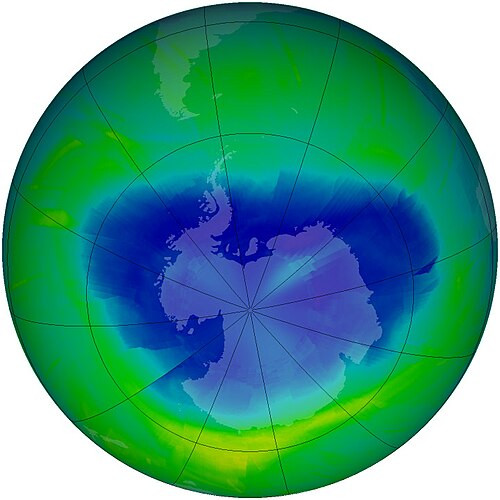
Antarctic ozone hole in 2010
Image:NASA Goddard Space Flight Center from Greenbelt, MD, USA,
Public domain, via Wikimedia Commons
.jpg)
Words
- agreement = promise to do something about a problem, made by two or more people or countries
- ban = forbid, not allow
- become aware = here: know that a problem exists
- cancer = bad disease in which cells in a part of the body grow in an uncontrolled way
- cause = lead to
- century = a hundred years
- chloroflourocarbons = a gas that damages the ozone layer; it is in refridgerators an spray cans
- continue = keep on
- destroy = damage completely
- discover = to find for the first time
- escape = to set free
- especially = above all
- estimate = to calculate something based on the information you have
- government = the people who rule a country
- harm = to put in danger
- located = to be found; where something is
- recover = here: to get better
- scientist = a person who is trained in science and works in a lab
- shield = here: layer that protects us
- sign = to put your name on a document
- spray can = can that forces liquid out in very small drops
- surface = the top part of an object
- treaty = a written agreement between countries
- vital = very important and necessary