
Layers of the Atmosphere
Troposphere
|
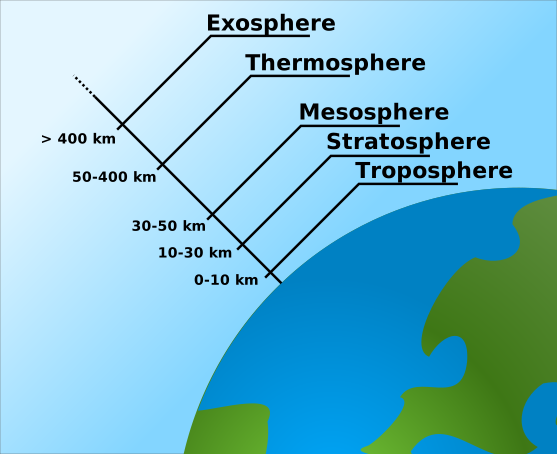
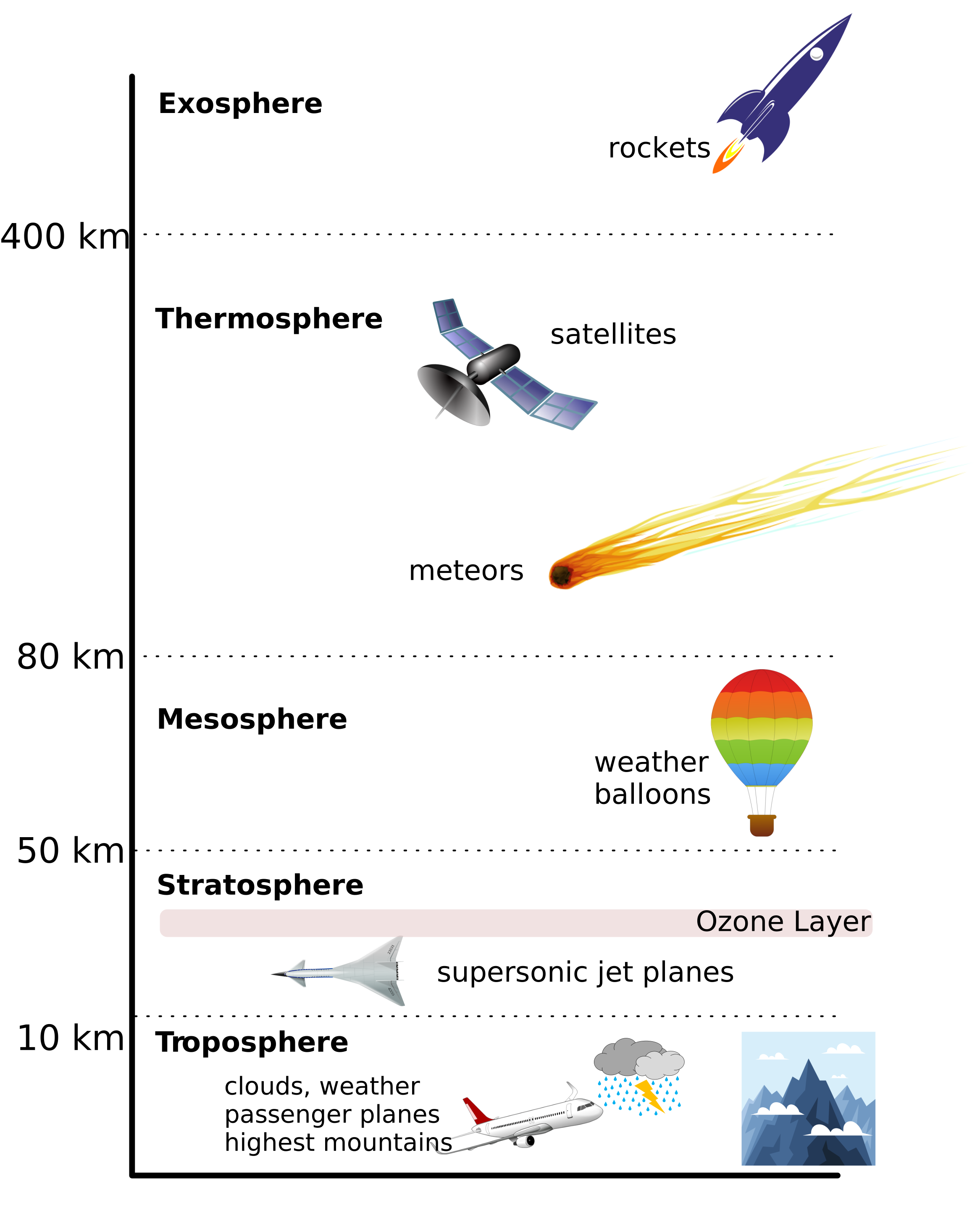
The troposphere is the layer closest to the Earth’s surface and the part of the atmosphere that we This lower part of the atmosphere is responsible for our weather. Water evaporates from oceans and rivers and forms clouds which can produce, rain or snow. Winds also get stronger the higher you go up. At the top of the troposphere so-called jet streams reach speeds of up to 300 km an hour. As you go up the air gets thinner. People must wear pressure suits and use oxygen masks when they travel to higher regions. The troposphere helps to keep the temperatures on earth moderate. |
Layers of the atmosphere |

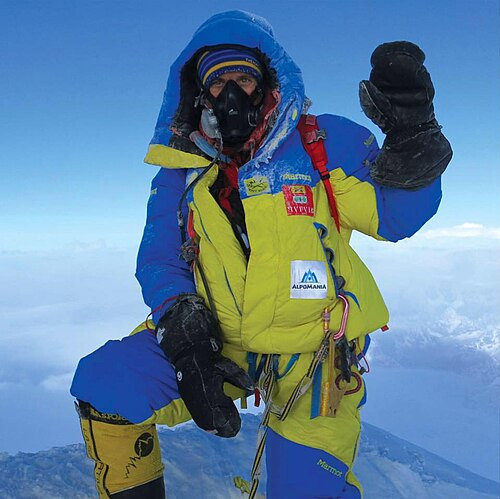
Climber wearing an oxygen mask at the top of Mount Everest
Image:Валентин Сипавин, CC BY-SA 4.0,
via Wikimedia Commons

Stratosphere
The second layer of our atmosphere is the stratosphere. It extends up to an altitude of 50 km above the Earth’s surface. A gas called ozone causes the temperature to rise again. Ozone absorbs the ultraviolet light that comes from the sun and changes it into heat. Without ozone this dangerous light would reach the Earth’s surface , cause skin problems and harm plants and animals.
Mesosphere
The mesosphere extends from the top of the stratosphere to about 80 km. The air becomes even thinner and the temperatures drop again. At the top of the mesosphere they may be lower than -75° C.
Thermosphere
The thermosphere ranges from 80 km to about 400 km above the Earth. In this layer temperatures increase rapidly with altitude. At the bottom temperatures are below freezing, at the top they can reach over 1,000 °C. Satellites orbit the Earth at this height.
Exosphere
In the outermost layer of the atmosphere temperatures are steady, averaging around 1200°C. Molecules in the exosphere are so far away from each other that they normally don’t collide. The layer extends into outer space and joins with the atmosphere of the sun and other planets. Atoms and particles escape the Earth’s gravitation and float to outer space.
Layers of the atmosphere
Own work - All images public domain
Words
- absorb = to take in
- altitude = how high an object is above sea level
- cause = lead to
- drop = go down
- equator = a line around the middle of the Earth that divides it into two halves
- evaporate = to change slowly from liquid into gas
- extend = to go from one place to another
- harm = to put in danger
- height = how high something is
- increase = to go up
- jet stream = very strong winds at the top of the troposphere
- moderate = not too hot and not too cold
- orbit = to go around a planet or the sun
- oxygen mask = mask you put on if there is not enough air around you to breathe
- pressure suit = a special suit you must wear to survive when you fly at great heights
- range from ... to ... = to go from ... to ...
- rapidly = fast
- responsible = to cause something
- rise = to go up
- sea level = the normal height of the sea; you use it as a standard for measuring other heights
- speed = how fast something is
- surface = the top part of an object
- ultraviolet light = light that you cannot see but it makes your skin darker when you are in the sun