
The Make-up of our Atmosphere
Completion requirements
The air near the Earth’s surface consists of 77 percent nitrogen and about 21 percent oxygen. Carbon dioxide is also present, but only in small amounts. Nevertheless it is very important because green plants use it when they make their food. Higher up you can find helium and hydrogen in the atmosphere.
Not all gases are created by nature, some are produced by people. Methane rises into the atmosphere from decaying plants and animals. Carbon monoxide and chlorofluorocarbons (CFCs) enter the atmosphere because of industrial activities.
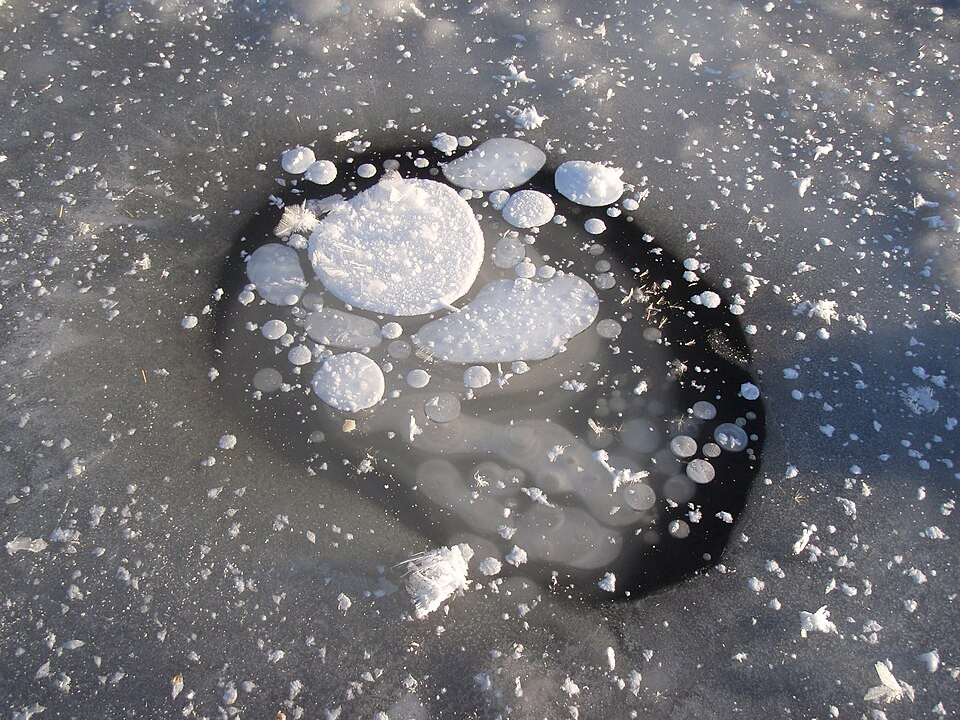
Frozen methane bubbles on a lake
Image:U.S. Geological Survey from Reston, VA, USA,
Public domain, via Wikimedia Commons
.jpg)
Words
- activity = thing that you do
- amount = quantity; how much of something
- carbon dioxide = gas that is produced when we breathe out or when carbon is burned
- carbon monoxide = a posionous gas that is produced when you burn fuel or wood
- chlorofluorocarbons (CFCs) = a gas that damages the ozone layer; it is in refridgerators an spray cans
- consist = is made up of
- create = make
- decay = to be slowly destroyed in a natural, chemical way
- helium = gas that is lighter than air and is used to make balloons float
- hydrogen = a colourless gas that is the lightest of all gases, forms water when it combines with oxygen
- methane = a gas that you cannot smell or see; it can be burned to give heat
- nevertheless = yet, but
- nitrogen = a gas that has no colour or smell
- oxygen = a gas that is in the air and that we need to breathe
- present = here: exist in the atmosphere
- rise = go up
- surface = the top part of an object