
Arts and Architecture
In the Renaissance artists and architects used mathematics to plan their works. They discovered that many objects in nature have a certain proportion. They called this the golden mean. It is often found in the shape of a leaf or in the form of buildings. Many of them found out that the human body also displayed proportions. Renaissance architects built new buildings that were symmetrical.
Artists of the Renaissance started to experiment with perspective in their works. They learned that if they made an object smaller and put it in the background of a picture it appeared farther away. They also painted with more realism than earlier artists.
Many great artists of that time started their studies or worked in Florence. Michelangelo was the most famous artist of the Renaissance. He studied painting and sculpture in Florence, where he created his famous sculpture of David for the Florence cathedral . In his later life he painted the ceiling of the Sistine chapel in the Vatican—probably his most famous piece of art.
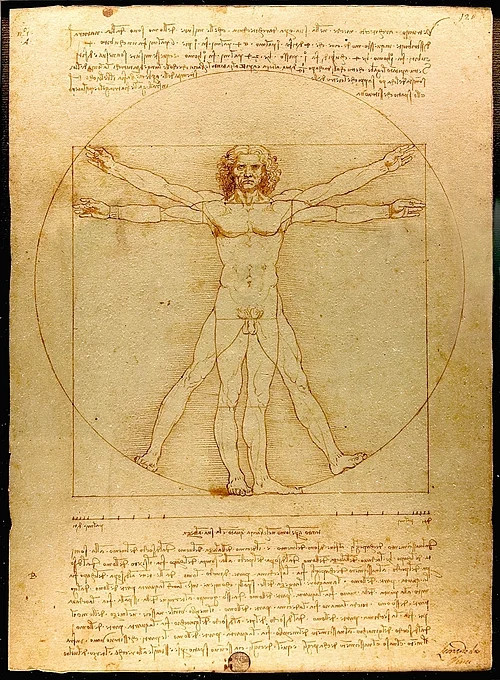
Leonardo da Vinci’s "Vitruvian Man"
Image: Leonardo da Vinci, Public domain,
via Wikimedia Commons

Words
- appear
- 1. here :come into view
- 2. show, look
- artist = person who creates paintings, drawings or sculptures
- ceiling = the top part of a room
- discover = to find something for the first time
- display = show
- golden mean = mathematical ratios and how they relate to each other
- perspective = way of drawing that makes things look closer or farther away from each other
- proportion = relationship
- realism = as things are in real life
- shape = the form that something has
- studies = to learn something at a college or university
- symmetrical = an object that has two parts of the same form and size