
Exploration and Trade
Exploring the seas and sailing to other continents became very important during this era. Sailors had better instruments and maps, ships were built so that they could endure longer journeys. Most of them had big sails that were driven by strong winds.
Portuguese navigators started to explore the western coast of Africa from which they brought gold and ivory home. Later on, they discovered that sailing around the southern tip of Africa would bring them to India and Asia. These places offered spices, valuable cloths, and silk. Explorers brought them home and sold them to wealthy families in Europe.
After Columbus had discovered America in 1492, many Spanish, French and Italian explorers followed. The Spanish were the most successful. They conquered much of Central and South America and brought home gold and silver from the Inca and Aztec empires.
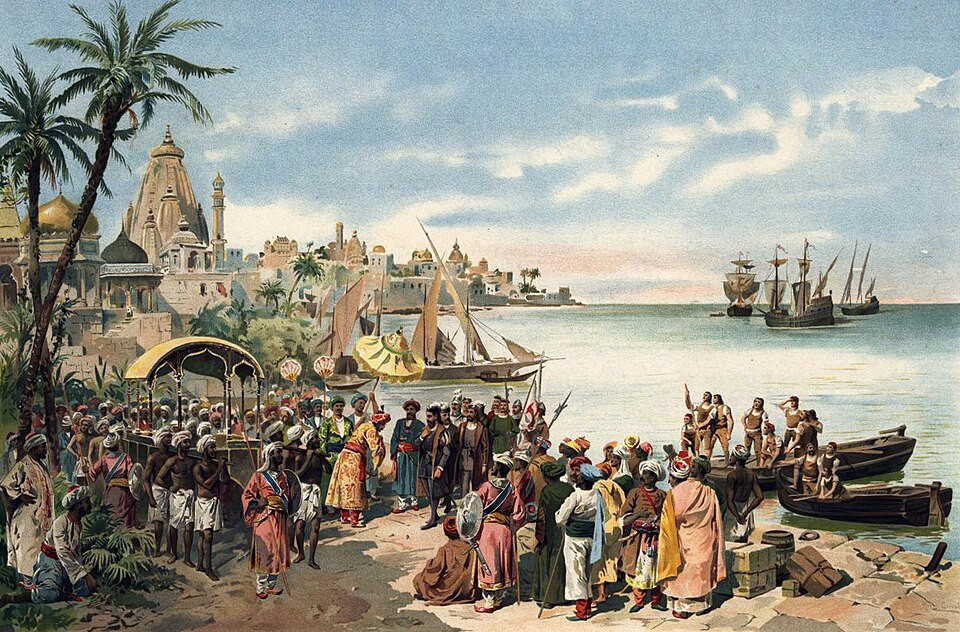
Portuguese explorer Vasco da Gama arrive in India in 1498
Image:Roque Gameiro, Public domain,
via Wikimedia Commons

Words
- cloth = material used for making clothes
- conquer = to control a country by fighting
- discover = to find something for the first time
- empire = a very big country controlled by a king or queen
- endure = here: make
- era = time, age
- explore = to travel to a place and find out something about it
- ivory = the hard yellowish white material from an elephant‘s teeth
- journey = trip
- map = a drawing of a country that shows where the cities, lakes, roads, or rivers are
- navigator = a person on a ship who tells you which way to go
- sailor = a person who works on a ship
- silk = thin, smooth cloth made from thread that is produced by the silkworm
- spices = powder or seeds from plants that we use to give food a special taste
- tip = end
- valuable = worth a lot
- wealthy = rich