
Erik the Red and Leif Erikson
Erik the Red was a famous Viking explorer who lived at about 950 A.D. He got this name because of his red hair. When his father had to leave Norway because he had killed somebody, Erik went with him. The family settled in Iceland.
Erik decided to explore the island and when he sailed west he discovered Greenland.
In 985 he persuaded some friends and relatives to go to Greenland with him. Two towns were founded there with a total of about 400 people. Erik became the leader of these two towns. Some settlers were farmers and raised cattle pigs and sheep. Others hunted bears and other animals.
When Erik died his son Leif Erikson became the leader of the towns in Greenland. He also continued the voyages of his father and led the first Viking expedition to the coast of North America.
In 1002 Erikson sailed west from Greenland. With a crew of 35 men, he landed on a shore where he met natives who grew grapes. The men made wine from the grapes and Erikson named the place Vinland.
Nobody knows where Erikson exactly landed, because there were no maps at that time. Many historians think that the landing place was an island near today’s coast of Newfoundland. Archaeologists found the ruins of an old Viking settlement there. Others think that Erikson may have travelled as far south as Massachusetts.
Over the following twenty years the Vikings founded many settlements in the new world but they didn’t last very long.
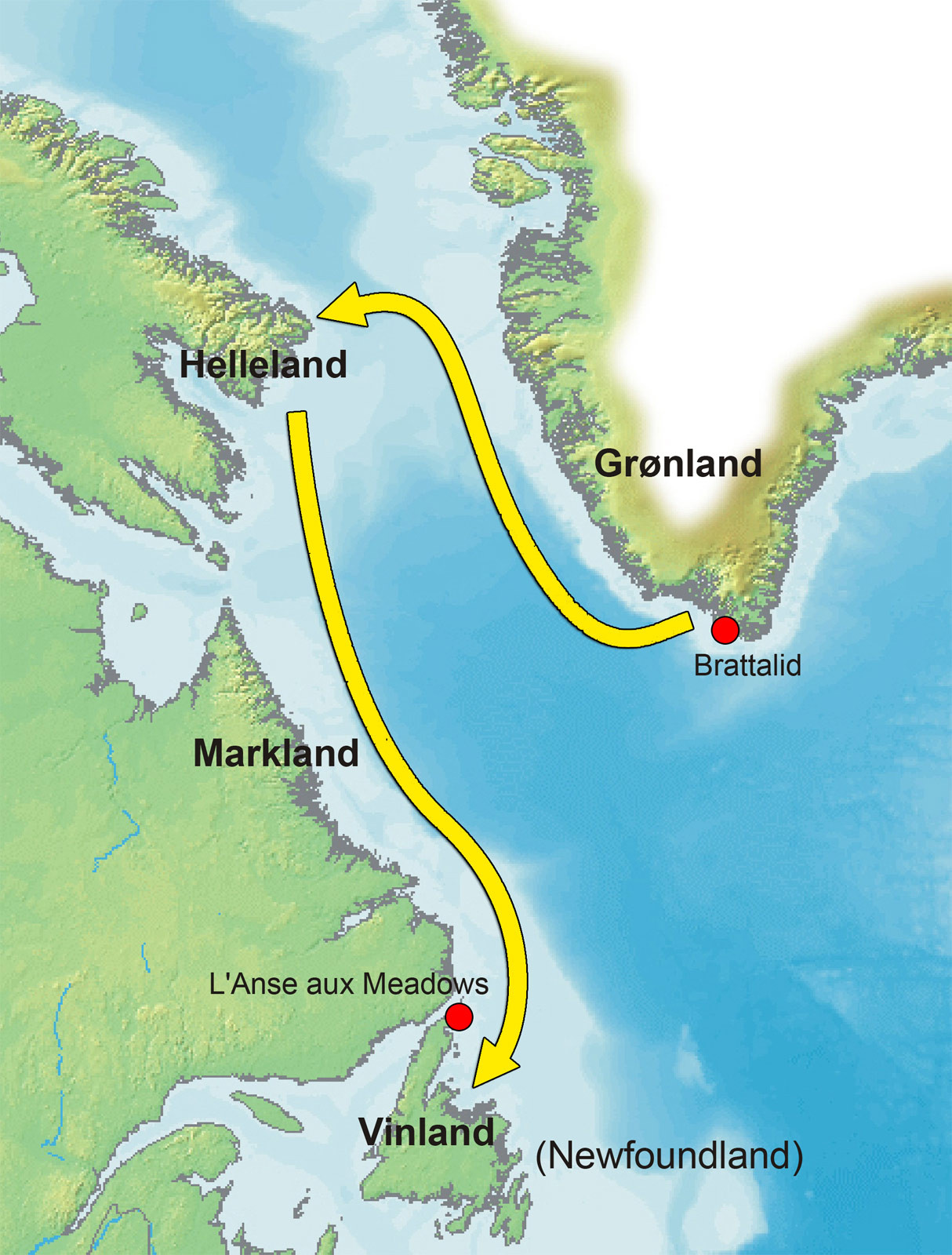
Leif Erikson's journey to the New World
Image:Finn Bjørklid, CC BY-SA 2.5,
via Wikimedia Commons

Words
- A.D. = after the birth of Jesus Christ
- archaeologist = person who studies what is left of cities, towns and old buildings
- coast = where land meets the sea
- continue = here: to keep on doing something
- crew = all the people who work on a ship
- discover = to find something that you didn’t know before
- explorer = a person who travels around and tries to find out something about new places
- found - founded = to start or create something new
- historian = a person who studies what happened in the past
- map = a piece of paper that shows where countries, towns, rivers, cities etc.. are
- natives = people who have lived in a place all the time
- persuade = to make someone do something by giving them reasons for doing it
- raise cattle = to feed cows so that they can be used for getting meat or milk
- ruins = the part of a building or a small town that hasn’t been destroyed
- settle = to start living in a place where not many people have lived before
- settlement = a small new town or village
- shore = coast; where land meets the sea
- voyage = trip by boat