
How Hurricanes Start
Hurricanes are born over tropical oceans, usually during late summer and early autumn. They need two things to get them started: heat and moist air.
During the summer the ocean surface heats up, and warm moist air starts to rise. Cool air sinks down to replace it. This creates an area of low pressure.
The rotation of the earth creates winds around the centre of such a low-pressure area. In the northern hemisphere the air moves counterclockwise , in the southern part clockwise. Such a system is called a cyclone.
When warm air rises it cools. As a result, clouds and thunderstorms form and it starts to rain.
All hurricanes begin as cyclones, but not all cyclones become storms or hurricanes. Some die out a few days after they start. They don’t have enough energy to become a hurricane. When winds are stronger than 119 km an hour a storm officially becomes a hurricane.
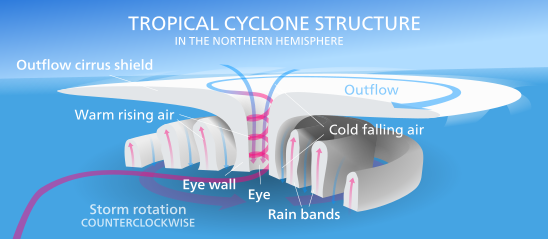
Tropical cyclone in the northern hemisphere
Image: Kelvinsong, CC BY 3.0 , via Wikimedia Commons
Words
- clockwise = in the direction in which the hands of a clock move
- counterclockwise = in the opposite direction of the way that the hands of a clock move
- create = make
- hemisphere = half of the Earth
- low pressure = place where the air is not very heavy ; it goes up
- moist = wet
- officially = formally, publicly
- replace = to take something's place
- rise = go up
- surface = the top layer of something
- thunderstorm = a storm with thunder, lightning and sometimes a lot of rain