
Napoleon's Decline and Final Years
After his defeat in Russia, Napoleon’s enemies saw their chance. One by one they rose against him. Britain, Austria and Prussia joined Russia in their fight against Napoleon. The French were defeated in the Battle of Leipzig in today’s Germany. In 1814 the enemies captured Paris and Napoleon had to give up his throne.
France became a monarchy again and the country once again had a king, Louis XVIII. Napoleon was banned on the island of Elba near Corsica, where he stayed for only 10 months. In March 1815 he escaped from prison and, together with his old supporters, began a march on Paris. The king fled and for a short time Napoleon once again ruled France. This period, known as the Hundred Days, ended on June 18, 1815 when Napoleon was defeated for the last time at the Battle of Waterloo, Belgium.
After this final defeat, Napoleon was taken prisoner by the British, who put him on the tiny island of St. Helena in the South Atlantic. He stayed there until he died in 1821.
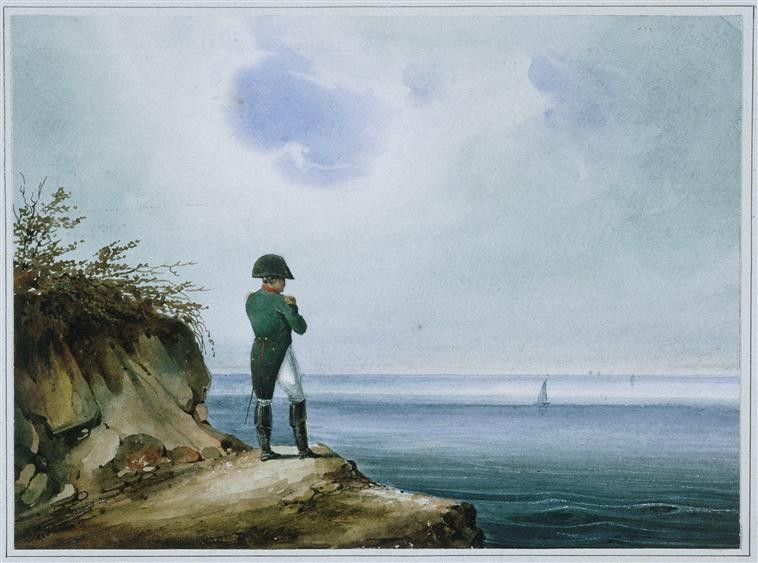
Napoleon on St. Helena
Image:František Xaver Sandmann, Public domain,
via Wikimedia Commons

Words
- ban = here: to send away
- defeat = to win against someone
- enemy = someone who hates you and whom you fight against
- escape = get away from
- one by one = one after the other
- monarchy = country ruled by a king or queen
- prison = a building where you keep people if they have done something wrong
- Prussia = a German state in northern Europe that was very powerful between the 17th and 19th centuries
- rise - rose = here: to stand up
- supporter = someone who helps a person
- throne = a special chair used by a king or a queen to sit on
- tiny = very small