
Background and Causes
When Louis XVI became king of France in 1774 the country had many problems. His biggest problem was that he didn’t have any money. France helped the American colonists in the American Revolution . There were long and hard winters and most people didn’t have anything to eat. So Louis decided to get money from the noblemen of France because the peasants didn’t have any.
Louis was a weak king, and he didn’t know anything about ruling a country. He married Marie Antoinette, the daughter of Austrian empress Maria Theresia.
For many hundred years, the Estates-General was an assembly that represented the “estates” or classes of France. There were three of them.
- The First Estate was made up of religious leaders and the clergy.
- The Second Estate were the aristocrats and noblemen.
- The Third Estate were peasants, workers and members of the middle class. These people paid most of the taxes, but they had very little power in France.
In June 1789 the Third Estate made itself independent and got together as the National Assembly.
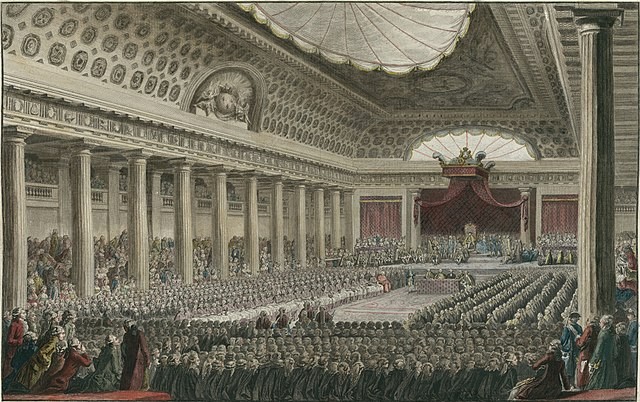
Opening of the Estate-General on 5 May 1789 in Versailles
Image: Isidore-Stanislaus Helman (1743-1806) and Charles Monnet (1732-1808),
Public domain, via Wikimedia Commons

Words
- aristocrat = same as nobleman
- assembly = meeting of representatives
- clergy = the people who work for the church
- colonist = person who goes away from their home country and lives in a place far away; they are still ruled by the king or queen
- empress = a woman who is the ruler of a group of countries
- independent = to govern yourself, to be free
- nobleman = a man who is a member of the highest social class
- peasant = poor person who lives in the country and doesn't have any land
- represent = stand for, symbolize
- rule = govern
- tax = the money you have to pay to the government