Famous Romans
| Site: | English Across the Curriculum |
| Course: | The Roman Empire (A2-B1) |
| Book: | Famous Romans |
| Printed by: | Guest user |
| Date: | Friday, 16 October 2026, 5:12 AM |
1. Julius Caesar
Julius Caesar may be regarded as Rome’s most important general and statesman. He was a great military leader and won many battles that helped him gain power and, in the end, made him the sole ruler of Rome.
During his military career he conquered Gaul, invaded Britain and kept Germanic tribes out of the empire.
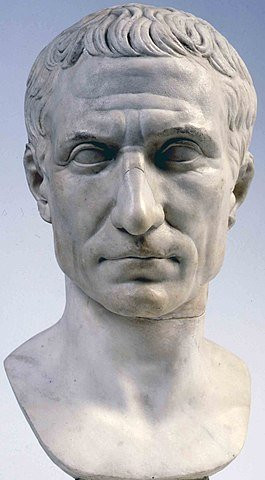
Julius Caesar
Image: Unknown author, Public domain,
via Wikimedia Commons
.jpg)
Words
- battle = fight in a war
- conquer = to take control of an area with an army
- gain = get
- Gaul = region of Western Europe; today's France
- Germanic tribes = people who lived to the north of the Roman Empire
- regarded = to think of someone as ....
- sole = alone, only
- statesman = a politician or leader who is respected by many
2. Augustus
Augustus was born as Octavian, son of a rich Roman banker. His great-uncle Julius Caesar adopted him and made him his heir. After Caesar’s death, Octavian formed an army to fight against Mark Antony, who took over control of Rome from Caesar. The two men came to an agreement and shared control of the Roman Empire. They also defeated Caesar’s murderers. When Octavian found out about the love relationship between Mark Antony and Queen Cleopatra of Egypt, he saw this as a threat to the Roman Empire and turned against Antony. After Antony’s death, Octavian was given the name Augustus and became Rome’s first emperor.
Under his reign, Augustus expanded Rome’s territory. He conquered the Iberian Peninsula and pushed the boundaries of the Roman Empire north to the Danube River. He also gave orders to restore old buildings that needed repair and built roads to the outskirts of the empire.
After his death, Augustus was worshipped in Rome because of his successful reign .
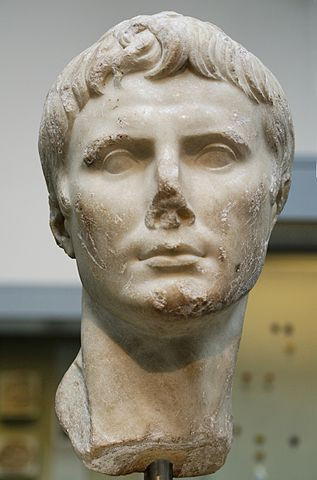
Bust of Augustus
Image : © Marie-Lan Nguyen / Main Page / CC-BY 2.5
Words
- adopt = to take someone else's child into your home and become its parents
- agreement = arrangement, deal
- boundary = line that separates two countries or areas
- conquer = to take control of an area by fighting
- emperor = king or queen who rules over many countries
- expand = to make larger
- heir = a person who will take over something after you die or who will get everything that belongs to you
- Iberian = about Spain and Portugal
- outskirts = outer areas, places that are far away from the centre
- peninsula = land with water on three sides
- reign = time in power
- restore = rebuild, repair
- territory = land
- threat = danger
- worship = pray to someone and admire them
3. Nero
Nero was 17 when he became emperor of Rome in 54 A.D. He turned out to be a ruthless ruler who had his mother killed. But at first Nero was good-natured and a sensible leader. He focused on improving trade and the cultural life of the empire. However, as time went on, Nero became more violent and unpredictable.
According to rumours, he laid a fire that destroyed most of Rome. He blamed Christians for setting the fire and persecuted them throughout his reign. In 68 A.D. Nero saw that he no longer had the support of the Senate and committed suicide.
Words
- according to = as said or shown by ...
- blame = to say it is someone else's fault
- commit suicide = to kill yourself
- focus = concentrate on
- had his mother killed = he ordered someone else to kill her
- improve = to make better
- persecute = to treat someone cruelly or badly over a certain time because of their religion or what they think
- reign = time in power
- rumour = information that is passed on from person to person and does not always have to be true
- ruthless = cruel, violent, cold-blooded
- sensible = reasonable ; to make good decisions
- support = approval, help
- trade = to buy and sell things
- unpredictable = a person who changes their ideas a lot, so that you never know what they really think
4. Romulus and Remus
Romulus and Remus were twins who supposedly founded the city of Rome. According to the legend, their parents abandoned them at an early age, placed them into a basket and put it into the river Tiber. A wolf discovered the basket and brought it to a shepherd, who brought up the twins.
When they became adults, the brothers argued over which hill to build a city on. After a following fight, Remus was killed and Romulus became the first king of Rome. He was a popular ruler and a great military leader.
Words
- abandon = leave
- according to = as told by ....
- argue = to have a quarrel; fight
- discover = find
- found - founded = create; start something new
- place = put
- popular = liked by many people
- shepherd = someone whose job it is to take care of sheep
- supposedly = so people say
- twins = two children born at the same time to the same mother
5. Marcus Brutus
Marcus Brutus was a Roman statesman who helped assassinate Julius Caesar because he wanted to break his power. On March 15, 44 B.C. Brutus and other men stabbed Julius Caesar to death as he entered a meeting of the Senate.
After the Senate took over control of Rome again, Brutus was sent to govern the eastern part of the Roman Empire. In 43 B.C. Brutus killed himself after he had been defeated by Octavian and Mark Antony in the Battle of Philippi.
Words
- assassinate = murder an important person
- defeated = lost
- govern = rule
- stab = push a knife into someone
- statesman = politician or leader who is respected by many
6. Hadrian
Hadrian became Roman emperor in 117 A.D. He was especially known for construction projects. He completed the Roman Pantheon and built a stone wall across northern Britain to defend the empire from outsiders. Hadrian travelled to almost every corner of the empire. He admired Ancient Greece and wanted to make Athens the cultural centre of the empire. Hadrian was considered to be a peaceful emperor. He died in 138 A.D.
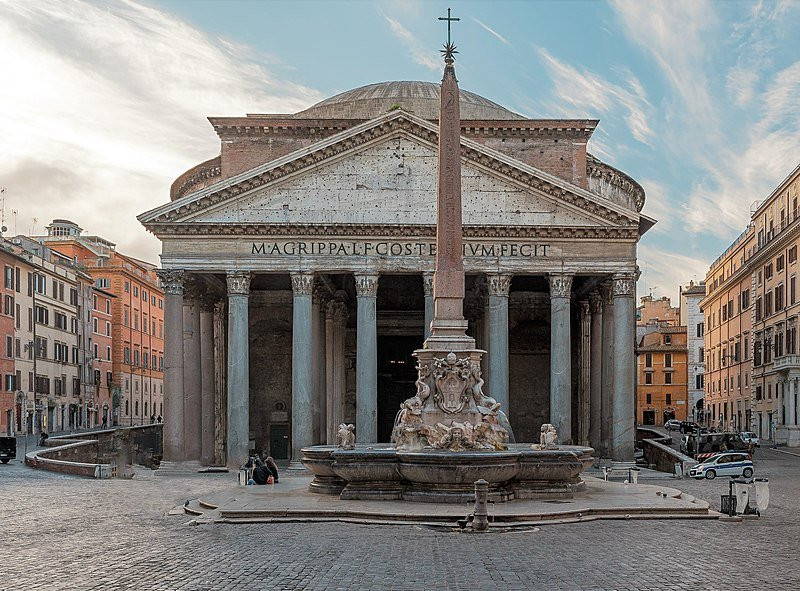
The Pantheon in Rome
Image: Rabax63, CC BY-SA 4.0,
via Wikimedia Commons

Words
- A.D.= after the birth of Christ
- admire = like; have a high opinion of
- considered = thought
- construction = building
- defend = guard , protect
- especially = above all
7. Virgil
Virgil was Rome’s greatest poet. Born in northern Italy in 70 B.C. he started writing during his studies in Rome and Naples. His most famous work was the Aeneid, which was left uncompleted. Based on Homer’s Odyssey and the Iliad, Virgil describes the adventures of the Trojan hero Aeneas, who sailed westwards and founded the city of Rome. In the epic poem, Virgil shows the greatness of Rome and his admiration for its rulers.
In other poems, Virgil wrote about country and peasant life. After his death, Virgil’s influence spread throughout Rome. Roman schools taught their pupils about him and made them read his poems. Writers in the Middle Ages often referred to Virgil in their works.
Words
- admiration = feeling of respect and liking for
- based on = to use something as a starting point
- epic = very long
- found - founded = create, start
- greatness = how great and successful something is
- influence = power
- Middle Ages = time between the collapse of the Roman Empire and about 1500
- peasant = poor farmer who owns very little or no land at all
- poem = piece of writing in rhymes that shows a person's ideas and how they feel
- poet = someone who writes poems
- refer to = here: to speak about someone
- throughout = in all of
- uncompleted = not finished
- work = piece of writing
8. Cicero
Cicero (106 – 43 B.C.) was a great Roman philosopher, speaker, and writer. He was one of the most important translators from Greek to Latin. Banned from Rome by the first triumvirate, he was later allowed to return. He was killed because of his opposing views. Even today, Latin students around the world read the works of Cicero.
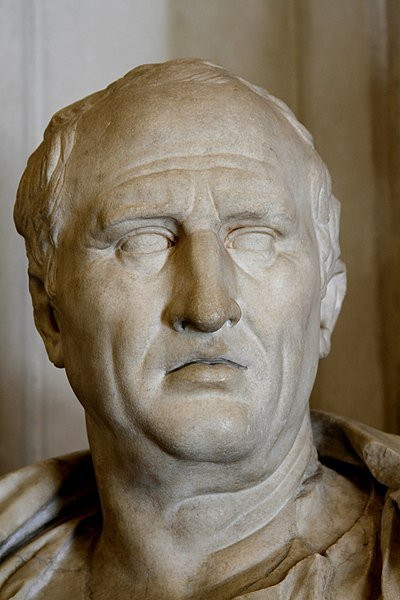
Bust of Cicero
Image:José Luiz Bernardes Ribeiro ,
via Wikimedia Commons
Words
- banned = not allowed to be in ...
- opposing = completely different from each other
- philosopher = someone who studies the ideas of nature and existence
- translator = person who changes written or spoken words into another language
- triumvirate = a group of three powerful people who ruled Rome
- works = writings
9. Constantine
Constantine I (275 – 337 A.D.) was the first Roman emperor to convert to Christianity. When he ruled Rome, the Christians and other religious groups got their freedom. He rebuilt Byzantium, and named it Constantinople, the Christian capital of ancient Rome.
Words
- capital = most important city
- Christianity = a religion based on the life and beliefs of Jesus Christ
- covert = to change your religion
10. Pontius Pilate
Pontius Pilate was a Roman governor in Judea during the time of Jesus Christ. He became famous as judge at the trial of Jesus Christ. He had Jesus killed for treason because he claimed to be the king of Jews. Leaders of Judea thought of him as dangerous to the Roman Empire.
According to the Bible, however, Pilate claims he did not want to have Jesus Christ crucified.
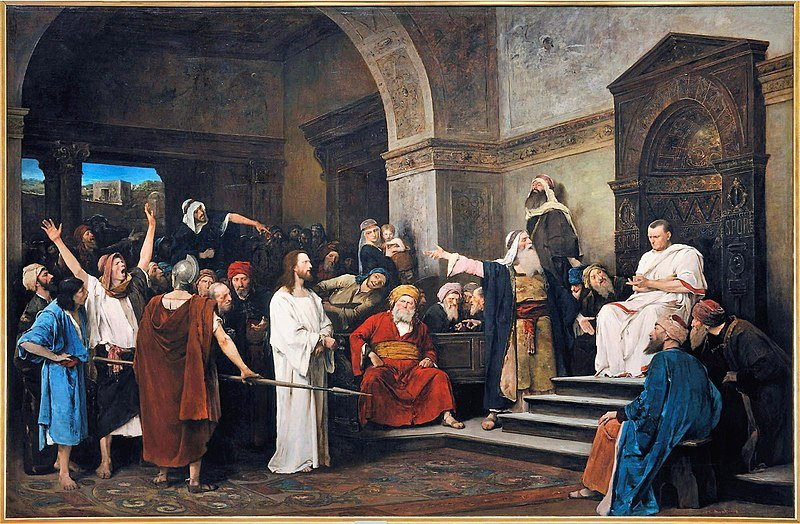
Painting that shows Jesus Christ appearing before Pontius Pilate
Image: Mihály Munkácsy, Public domain,
via Wikimedia Commons

Words
- according to = as told by ....
- claim = to say that something is true even if not everyone believes it
- crucify = to kill someone by nailing them to a cross
- governor = a person who rules a territory or country for the king or emperor
- Judea = old name for the region around Jerusalem
- judge = person in court who decides if someone has committed a crime
- treason = to betray your country or government
- trial = when a court decides if a person is guilty of a crime