
Introduction
Section outline
-
Tropical rainforests are woodlands around the equator with a lot of vegetation that is evergreen. It is very warm and rain falls throughout the year.
Although only 7 % of the land surface are covered with rainforests, more than half of the world’s plants and animal species live there.
Rainforests are very important for human beings. Plants produce food and medicine, and we get industrial products out of some of them. Trees produce timber, help control the earth's climate and supply us with fresh air.
Despite these advantages, people cut down thousands of square kilometres of rainforest every year.
Half of the world's rainforests can be found in the Amazon River basin in South America. Smaller rainforests lie in Central America and southern Mexico. The western part of Africa has about 2 million square kilometres of rainforest in and around the Congo River basin. Rainforests in Asia are found in southern India, Malaysia and on many Indonesian islands.
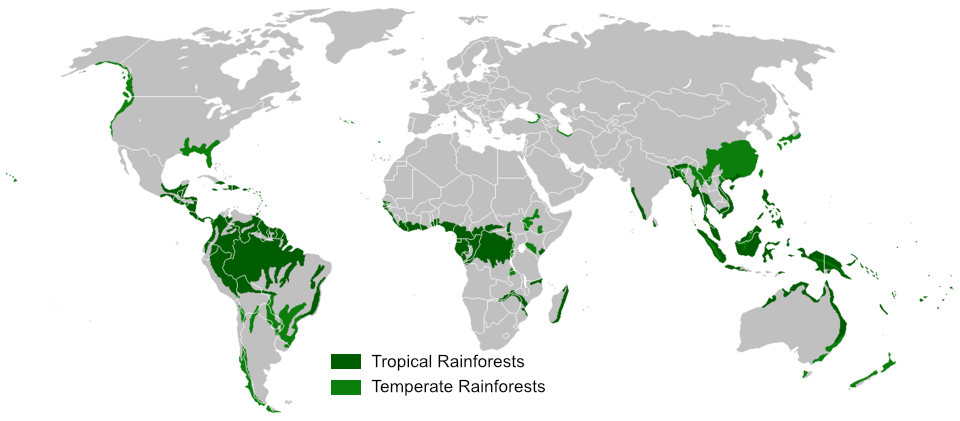
Image (modified) :Ville Koistinen (User:Vzb83), CC BY-SA 3.0,
via Wikimedia CommonsWords
- advantages = the good sides of something
- basin = an area of land that is lower in the middle ; usually, a big river flows through it
- despite = here: even if there are ...
- equator = a line around the middle of the earth
- evergreen = when a plant or tree does not lose its leaves in the winter
- human beings = people
- species = group of animals or plants that are like each other
- supply = give
- temperate rainforests = these rainforests also have trees that lose their leaves every year
- throughout = in the whole
- timber = the wood that you use to build houses